Supply Chain Management and Logistics Blog. Posts are about end-to-end supply chain management and logistics in a time of challenging disruption.
Tom provides leading supply chain management and logistics consulting and advisory assistance based on real-world experience.
He brings authority and domain expertise to clients.
Email Tom at: tomc@ltdmgmt.com
Check Tom's profile at: https://www.linkedin.com/in/tomcraig1/
Neither snow nor rain nor heat nor gloom of night will stay Amazon’s drones from the swift completion of their appointed rounds. In a patent application from last month, uncovered by the BBC yesterday, the retail giant outlined a plan for its proposed delivery drones to get packages to you in half an hour, regardless of where you are.
Up to now, Amazon’s drone plans have suggested they would arrive at your doorstep, dropping off packages like a smaller, louder mailman. But Amazon’s application suggests the company is exploring ways to have its drones come directly to wherever your smartphone is.
The application outlines a process whereby an Amazon customer orders something small—a book, perhaps, or maybe a box of Tide—via the Amazon app and selects the “Bring It To Me” delivery option. The nearest drone delivery system hopper would then saddle the drone with the order and deploy it to the location of the customer’s smartphone.
Amazon’s proposed drone mothership.(US Patent and Trademark Office)Once within range, the drone then will perform a controlled landing by somehow using the camera function of the customer’s smartphone to navigate a path from the sky to the ground. Exactly how is a little unclear, though the patent notes that the customer could theoretically land the drone herself. Presumably, though, the customer would have to make sure their phone was somewhere safe, in case the drone had to make a hard landing.
Not that landing is essential. The patent application suggests the drone wouldn’t have to actually touch the ground to drop off your delivery—it could just hover near you, release its package, and be on its merry way. The filing also says that Amazon wants to its drones to communicate with each other while in the air, “to share weather information, location information, routing information, landing areas.”
There are still a few hurdles that Amazon will have to clear before drones whiz through the skies bearing urgent deliveries of paperbacks and gluten-free pasta. There’s no guarantee that the US authorities will approve the patent, nor that Amazon will end up implement the technology if it does. The company is also still hoping for approval from the US’s aviation administration and other countries’ regulators for use of a drone program that wouldn’t require Amazon to keep drones within the line of sight of human operators. (Unlike the drones of its proposed delivery service, Amazon’s comment on its plans did not materialize immediately upon request.)
E-commerce Immediacy will break many companies and their supply chains, as it drives across multichannel, industries, markets, and the world. Hello Blue Ocean Supply Chain.
Blue Ocean Supply Chains will be a challenge for many 3PLs and Logistics Service Providers. The change from a commodity service position may be too daunting.
Customers like the convenience of online ordering. Why will Wal-Mart--and all those who do click and collect--make customers pick up their orders. It is about the customers--not the retailers.
Wal-Mart’s Mission: Connecting Customers With Online Orders
Retailer focuses on creating pickup points for goods ordered online
Wal-Mart Stores Inc.WMT1.28% is experimenting with “click and collect” and focusing on creating more pickup points for goods ordered online.
The retailers wants to “provide choice and convenience through dynamic distribution points” such as stores and other locations, as well as home delivery, Tracy Rosser, Wal-Mart’s senior vice president for transportation and supply chain, said. Mr. Rosser was addressing an Institute for Supply Management conference this week in Phoenix.
The company is testing such an access point in Bentonville, Ark., where Wal-Mart has its headquarters. Mr. Rosser compared it to a Sonic fast-food restaurant, where customers can specify a pickup time frame, drive to the location, present an order number, collect ordered items and depart.
Retailers are looking for ways to serve the growing e-commerce market while also maintaining traditional distribution apparatus for their stores. The world’s largest retailer is accustomed to moving ”truckloads of merchandise that was going to stores for customers to buy,” said Mr. Rosser, who manages Wal-Mart’s 6,000-truck domestic transportation fleet.
But “now, if you’re supplying Wal-Mart, you’ve got a customer who might have already purchased that product and paid for that product. That requires a whole different level in terms of precision, pickup performance, and distribution through the stores or to the home, because the customer has already given you the money. They want to know when it’s going to be there and what condition it’s going to arrive in,” he said.
Next-day delivery services are “becoming the norm” at some big retail chains and as Amazon.com improves fast delivery by opening fulfillment centers near major population centers, Mr. Rosser said. Wal-Mart has at least 70 home-delivery trucks of its own, and its selection of items available both online and in stores has grown from a few hundred thousand to about 8 million, Mr. Rosser said.
“It’s the biggest change I’ve ever seen,” he said. That said, Wal-Mart’s built-in advantage is that it already has “more than 11,000 nodes of distribution” also known as its physical stores around the
world.
$1.75 trillion for bad inventory decisions. These firms are in the Red Ocean with their Red Ocean supply chains. They need to move to Blue Ocean Strategy Using New Supply Chain Management.
Report: Retailers lose $1.75 trillion in revenue worldwide
London -- Retailers worldwide lose a staggering $1.75 trillion annually due to the cost of overstocks, out-of-stocks and needless returns, according to new research from retail analyst firm IHL Group, commissioned by OrderDynamics.
The report, “Retailers and the Ghost Economy: $1,75 Trillion Reasons to be Afraid,” details the impact of overstocks, out-of stocks and needless returns — three of the primary components of the “Ghost Economy” haunting retail — on the $14.5 trillion retail economy worldwide. These inefficiencies result in “monies left on the table and the loss of sales that otherwise would be available,” according to the IHL study.
Here is how the losses stack up:
• Preventable returns: $642.6 billion each year • Out-of-stocks: $634.1 billion each year • Overstocks: $471.9 billion each year
For the majority of retailers, the combined impact of overstocks, out-of-stocks and preventable returns add up to 11.7% of lost revenue. Addressing the inefficiencies and data disconnects throughout their organization could mean the equivalent of adding $117 million in revenue for every $1 billion in retail sales — or an additional $2.9 billion in revenue for a $25 billion retailer.
“Retailers all too often focus on a variety of ways to drive revenue and increase comparable year-over-year sales, but retailers can realize huge gains by addressing opportunities that are in hand and slipping through enterprise fingers,” said Greg Buzek, president of IHL Group. “These problems are within retailers’ grasp to solve, but it requires more than data, more than business intelligence. It requires understanding the root causes of inventory and data disconnects and implementing the technology solutions and operational changes to address these revenue-limiting issues.”
Red Ocean Businesses and their Red Ocean Supply Chains focus more on cost than on service. In the new world of e-commerce immediacy and multichannel, they struggle because of that. Blue Ocean Supply Chain focuses on service to customers--where there is no competition.
Even if the carriers are able to implement such an increase--in light of existing contracts--will they turn around and give the increases away--as been their history--and why they are in such financial struggles?
The 15 container carriers that belong to the Transpacific Stabilization Agreement (TSA) and move nearly all the container traffic between the Far East and U.S. are recommending $600 per 40-foot container (FEU) general rate increases on both June 1 and July 1, as well as a peak season surcharge (PSS) of $400 per FEU that would take effect on July 1. The increases are intended to counter recent erosion in market rates, while the PSS will help cover contingencies from seasonal cargo surges, according to a statement from TSA. If the carriers are capable of raising rates by the full $1,600, it would represent a nearly 90 percent increase in rates from the Far East to the U.S. West Coast. A panel of carriers and forwarders who estimate spot freight rates for the Shanghai Shipping Exchange's Shanghai Containerized Freight Index last week pegged the spot rate from Shanghai to the U.S. West Coast at $1,783 per FEU and to the U.S. East Coast at $3,605 per FEU. TSA said its members are reporting 3 percent year-on-year first quarter cargo growth from Asia to the U.S., and "foresee an even stronger second quarter and a continuing need to improve revenue and restore service levels as the West Coast congestion situation eases." "The entire transportation and logistics sector is still digging out from a very difficult period, and all parties are eager to return to a more stable, predictable environment in moving goods to market," said TSA executive administrator Brian Conrad. "We’re fortunate that the U.S. consumer remains strong, port throughput is improving, and operational chokepoints have eased. But it must be remembered that baseline service levels come at a cost." Conrad emphasized that while overcapacity in the market will likely remain a consideration through 2016, it will not represent a major challenge. Responding to recently reported analyst forecasts predicting more than 20 percent overcapacity on U.S. East Coast services and downward pressure on freight rates, Conrad pointed out that in several aspects the underlying capacity analyses were based on faulty assumptions. These analyses, according to Conrad, used the nominal shipyard-rated capacity of new vessels entering the trade and not the effective capacity after adjusting for vessel loading, berth and terminal capacity and other factors; double-counted services launched as much as a year ago as new, including services carrying significant cargo from the Indian Subcontinent or other out-of-scope cargo; overlooked the longer-term shift in demand to East Coast and Gulf Coast services, particularly via Suez; and assumed that most traditional West Coast traffic will return to West Coast ports once the current congestion situation ends. "Our carriers see a very different set of facts on the ground," he said, "with perhaps a 15 percent net capacity increase in a market segment that grew by 10 percent last year and by an annualized 22 percent in the first quarter – nearly half of that the result of organic growth, not congestion-related cargo diversion." Conrad added that East/Gulf Coast vessel utilization remains in the 95-100 percent range as of mid-April, and that lingering uncertainty over how much discretionary cargo shippers will resume moving via the West Coast makes it essential that carrier be prepared for contingencies going forward. TSA members include APL, China Shipping, CMA CGM, COSCO, Evergreen, Hanjin, Hapag-Lloyd, Hyundai, “K” Line, Maersk, MSC, NYK, OOCL, Yang Ming, and ZIM.
Ahead of the World Economic Forum’s East Asia Regional Meeting on April 19, we’re looking at how countries in the ASEAN group compare on key issues. Most ASEAN members have built their economies on the back of trade. But how well are they set up for future growth? The World Economic Forum’s Enabling Trade Index (ETI) suggests Singapore is the most trade-friendly nation, not only for the region but for the entire globe. However, no other ASEAN member gets into the top 20 and most are in the bottom half. Singapore saw the combined value of its imports and exports climb to nearly three times its GDP in 2012. The country leads the world in border administration, it established the world’s first national single window for trade (TradeNet) in 1989, bringing together more than 35 border agencies. As a result, Singapore Customs estimated that in 2012, the cost per Singaporean dollar of duty it collected was just 1.15 cents, a margin of 98.9%. However, the country scores comparatively poorly on foreign market access (13th) and in the use of information technology (8th). Malaysia is the best-performer among developing nations in Asia. In a region afflicted by red tape, corruption and lack of infrastructure, Malaysia is an outlier. It ranks a remarkable 14th for the availability and quality of transport infrastructure. Maritime connectivity is among the world’s best (5th) and measures to streamline border administration mean the fees for exporting a container from Malaysia are the lowest in the world, according to the World Bank. However, paperwork for exporters remains much higher than in neighbouring Singapore, and corruption is an issue. Thailand comes third within ASEAN and 57th in the world. It is particularly strong on foreign market access (12th) and on the availability and quality of transport infrastructure (28th) and transport services (39th). The costs to export are consequently very low (5th). But imports are more problematical. While costs to import are relatively low (21st), a complex structure of tariffs damages domestic market access (113th). Thailand’s performance on the operating environment for trading is weak. Scores on physical security are generally low with the business costs of terrorism (110th) notably so. Indonesia scores well for market access (20th) witha trade-friendlytariff regime. Indonesia exporters enjoy some of the lowest rates in the world (8th) and costs to import are also low (9th). But border administration presents challenges. Irregular payments in exports and imports (86th) and the Customs transparency index (101st) head the list of concerns on this measure. Weak take-up of information technology (81st) and the business costs of terrorism (109th) drag down what is otherwise a relatively good performance for the operating environment (61st). The Philippines does well on domestic market access (19th) and foreign market access (26th), but border administration (71st) is mired by corruption and red tape, two factors also contributing to weakening the general operating environment (82nd). Like many countries in the region, the Philippines’ biggest weakness is the lack of adequate transport infrastructure (96th). The shortcomings are the most severe in the airport (105th) and port (107th) infrastructure. Vietnam does well on foreign market access (28th) has very low costs to import and export (5th, 9th)but is generally weak on border administration (86th) due to complex administration and a notable issue with irregular payments in exports and imports (123rd). Cambodia comes top globally for foreign market access as a result of facing very low export tariffs. But the reverse is true for domestic market access (133rd) as a result of high import tariffs (125th). Border administration scores poorly (108th) due to the volume of paperwork and irregular payments in exports and imports (119th). Lao PDR also does well on foreign market access (4th) due to low tariffs (3rd) and poorly on domestic market access (121st). The country is let down by weak border administration (114th) and infrastructure (115th) — particularly the use of information technology. Myanmar isin line with the ASEAN trend and has strong foreign market access (6th) but weak domestic market access (97th). Border administration is ranked low (117th) and transport infrastructure (138th), transport services (133rd) and the operating environment (134th) are all towards the bottom of the league tables. Author: Mark Jones is Commissioning Editor for the World Economic Forum
Why is Hamburg Sud doing this? It lacks ultra-large ships. Has few customers in the trade--except for some large European NVOs. And carriers in the east-west trades have lost money. Curiouser and curiouser.
Speculation about Hamburg Süd joining Ocean3 grows
Such an alliance could have a "competitive edge," according to industry consultant Drewry.
Could the Ocean Three become the Ocean Four?
While Hamburg Süd is increasing its involvement in the major east-west trades, Ottmar Gast, the German carrier's chief executive officer told Lloyd's List there is no formal negotiation underway for the German carrier to join the Ocean3 alliance between CMA CGM, China Shipping Container Line and UASC.
But Hamburg-Süd also indicated last month the reason for its growing involvement in the east-west trades is "to expand the liner network and leverage the resulting logistical advantages."
"It now only seems a matter of time before these carriers make the formal announcement that Hamburg Süd is to become a fully-fledged member of Ocean Three, or Ocean Four as it will presumably have to be re-named,” said Drewry this week in Container Insight Weekly.
Hamburg-Süd said since collaborating with UASC earlier this year it has been "able to reduce its dependency on South America and offer its customers an extended network that is well accepted. It also allows the shipping group to tap new growth and cost reduction potential both on shore and at sea."
Information from ocean schedule and capacity database BlueWater Reporting shows that of the 55 services across 25 primary trade lanes on which Hamburg Süd provides vessels or takes slots, one or more of the Ocean3 carriers participate on 25 of them.
Seven of the 25 shared loops belong to the Ocean3 Alliance network, which operates services between Asia and North America, Asia and North Europe and Asia and the Mediterranean region.
Those 25 loops deploy 210 vessels with a combined average capacity of 149,627 TEUs, compared to 397 vessels with a total average weekly capacity of 271,484 TEUs in the overall 55 joint services in which Hamburg Süd participates.
Hamburg Süd partners with CMA CGM on 24 routes, with China Shipping on 13 loops, and with UASC on eight services.
"There is quite a bit of overlap," notes Ben Meyer, Container Analytics columnist for American Shipper. "CSCL only participates in one service with Hamburg Süd that does not also include CMA or UASC, and UASC doesn't participate in any without one of the other Ocean3 members."
Drewry believes a combination of the four carriers would be “logical” and said even while such an alliance would remain much smaller in total capacity terms than the 2M Alliance between Maersk and MSC, "it would have a distinct competitive edge thanks to its unique mix of east-west and north-south services, which could force the other mega-alliances to follow suit.”
Workers assemble pens at the A.W. Faber-Castell Stationery Co. factory in Guangzhou, Guangdong province. China’s economy is slowing, spurring policy makers to loosen monetary policy and pledge targeted steps to counter downward pressure. Photographer: Brent Lewin/Bloomberg
A Chinese manufacturing gauge trailed economists’ estimates in April as new orders declined, underscoring forecasts for policy makers to step up stimulus to shore up growth.
The final Purchasing Managers’ Index from HSBC Holdings Plc and Markit Economics was at 48.9, missing the median estimate of 49.4 in a Bloomberg News survey and lower than the preliminary reading of 49.2. Numbers below 50 indicate contraction.
With economic expansion threatening to dip below the leadership’s 2015 target of about 7 percent -- one state-affiliated group reportedly sees a 6.8 percent pace this quarter -- officials have already loosened monetary policy. Anticipation of more measures to come has helped stoke a rally in stocks the past two months.
“China’s authorities are becoming more concerned about the economic downturn,” Wang Tao, chief China economist at UBS Group AG in Hong Kong, wrote in a note Monday. “In the next couple of months, we expect the government to speed up infrastructure investment with enhanced support from policy banks and cut the benchmark interest rate.”
The Shanghai Composite Index of stocks initially dropped after the PMI report, before recovering to be 0.9 percent higher as of 11:33 a.m.
The deterioration in the report contrasted with the official manufacturing PMI for April that suggested a stabilization.
Monetary Policy
Policy makers cut interest rates and reduced banks’ reserve requirement ratios twice in the past six months to prevent a deeper slowdown. China’s Communist Party leaders vowed in a meeting Thursday to step up targeted measured to counter downward pressure.
“The economy is still not bottoming out,” said Larry Hu, head of China economics at Macquarie Securities in Hong Kong. “It’s pretty clear that policy makers will ramp up stimulus measures so it’s very, very likely that we will have another interest rate cut in May.”
The People’s Bank of China has also considered using a toolkit that includes unconventional policies such as a Pledged Supplementary Lending program that channels money to favored areas of the economy. The PBOC may inject liquidity via policy banks such as China Development Bank, Caixin magazine reported on Monday, citing an unidentified person.
“Early signs for April point to growing downside risks for the government’s 7 percent GDP growth target for 2015,” Bloomberg economists Fielding Chen and Tom Orlik wrote in a note. “The case for a further cut in interest rates, perhaps as early as May, continues to strengthen.”
Growing Shipping Alliances Are Straining Major U.S. Gateway Ports
Ocean carriers are cooperating on capacity on their new, larger ships, adding to handling problems
ENLARGE
The world’s largest container lines are joining forces to get the most out of their new, bigger ships, bringing more cargo to ports at concentrated periods. EPA/ALEX HOFFORD Photo: European Pressphoto Agency
A sharp growth in container ship sizes and alliances among the world’s biggest shipping operators is overwhelming U.S. major gateway ports during peak periods, costing millions to importers and exporters who can’t access their cargo on time and prompting the country’s marine watchdog to warn of legal action if the parties don’t deal with the mess.
Container shipping, which moves over 95% of the world’s manufactured goods, is largely controlled by around 15 mostly European and Asian operators, which recently have accelerated the pooling of operations within giant alliances to cut costs. Long a feature of maritime shipping, the alliances have grown in recent years as carriers have introduced bigger vessels that are least twice the size of those calling on U.S. ports for years.
The economic imperatives of carriers trying to get the most out of the new ships meet the cargo-handling limitations at ports such as those the largest U.S. gateways at Los Angeles and Long Beach. Upon arrival, containers often are randomly unloaded, which swamps terminal operators as they try to organize the metal boxes in stacks and move them to specific destinations by truck or rail.
“Existing terminals were designed two decades ago to handle ships half the size of today’s vessels, and with the alliances, six ships belonging to the same alliance can show up at five different terminals in Los Angeles and Long Beach.” said Gene Seroka, executive director at the Port of Los Angeles. “This disperses cargo over a wider array of facilities making it challenging for truckers to pick the containers as well for western railways to amass the cargo and move it to specific destinations.
“We have 13 different terminals in Southern California. So there is a lot of confusion in picking up cargo,” said Mr. Seroka.
Related Video
Severe congestion at Norfolk International Terminal in Norfolk, Va., and other ports around the country has made it difficult for the U.S. to keep up with growing shipping capacity. Photo: AP
For years, the workhorse vessel that moved goods across the Pacific had a capacity to carry between 5,000 and 7,000 containers and it would take up to 10 hours to move a container from the port. But over the past couple of years, ships calling at West Coast ports have doubled in size. At the height of the peak period late last year the congestion was so severe that it would take up to eight days to move a container out of port and on to major importers of Asian goods such as Wal-Mart Inc., Home Depot Inc. and others.
Mr. Seroka said that on average terminal operators had to pay $3 million in added spending a week to deal with the congestion.
California ports handle the largest share of cargo moved from and to Asia, everything from clothing and home appliances to toys, luxury goods and electronics coming in and packaged food, fresh produce and scrap metal going out. Peak periods include September and October when retailers prepare for the Christmas holidays and the first-quarter period before the Lunar New Year, when U.S. importers typically stock up for spring before Chinese factories shut down for up to two weeks.
Jon Slangerup, chief executive at the Port of Long Beach, says that as ships get bigger, they call to more ports in Asia where containers are loaded randomly, with little attention to the ownership of the containers or their final destination. When docking at multiple terminals at the West Coast, unloading the ships is also done randomly, straining port operators and truckers as they try to figure out which box goes where.
Historically, a single ship had its containers stocked in blocks, with each block destined for a particular location by a particular mode of transport. The process known as block stowage was for decades the preferred method for port operators and it worked well.
“In the past, we handled a container one to three times before it left port, Mr. Slangerup said. “Now, at peak times, it is five to eight times, and when it happened last year nobody really understood the magnitude of the problem. It wasn't expected or planned for and so the physical gridlock that ensued was very serious.”
Jonathan Gold, vice president of National Retail Federation which represents 18,000 U.S. retailers, says members also have been levied by shipping companies with congestion charges to compensate for the for the extra time a vessel stays at port while cargo is being shorted out.
“It’s a very large issue that adds major costs to cargo owners,” he said. “We want to see better port operations overall that moves cargo quickly. We need a wider conversation with everyone involved in the supply chain, but it will take years to deal with the problem.”
ENLARGE
The Morten Maersk Triple-E Class container ship, operated by A.P. Moeller-Maersk A/S. Chris Ratcliffe/Bloomberg Photo: Bloomberg News
The impact of the alliances isn't limited to the United States. European and Asian ports have moved faster to adopt the infrastructure needed to handle the megaships. Those ports still face congestion and the alliances exacerbate the problem, but the loading of containers bound for Europe is less of an issue in part because of different port handling procedures.
Last month, the Federal Maritime Commission, the U.S. marine watchdog, voted to call in all parties involved to discuss the issue and come up with proposals to address the problem. It said that in many cases, congestion charges are deemed unfair since importers, exporters and truckers aren't responsible for the delays, and the regulator warned it could penalize unfair practices by shipping companies and terminal operators.
“The message from cargo owners, importers and exports is loud and clear,“ said FMCFMC0.23% Commissioner Richard Lidinsky. “These alliances and their big ships are causing major problems at U.S. ports and by our vote all parties involved will have to sit down over the next 90 days identify what went wrong and come up with solutions. After that, the FMC will have a clear picture and if needed get involved in specific cases with investigations, subpoenas and fines.”
“We had shippers telling us they are being regularly charged for the congestion by shipping companies. The operators cause the congestion and they want to profit on top of it. This is unacceptable,” Mr. Lidinsky said.
Maersk Line, the world’s biggest container operator with 15% of global capacity, according to the Singapore-based maritime research group Alphaliner, says the larger vessels actually improve efficiency as the cost savings are largely passed on to customers.
The FMC and the marine regulators from the European Union and China is set to meet in Brussels in May to discuss whether the alliances are in line with international competition practices and their role in congestion at U.S. ports.
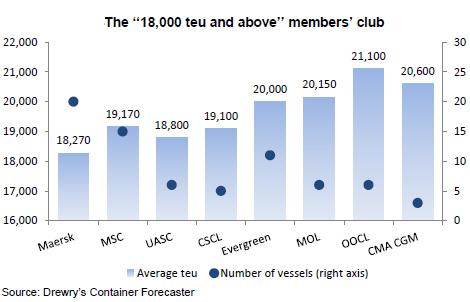
The big players in the business have said that pooling their resources and deploying bigger ships—such as the Triple-E class, which can carry in excess of 18,000 containers—cuts their costs and provides better service to cargo owners.
The world’s two biggest alliances in capacity terms are the 2M and Ocean Three.
The 2M consists of A.P. Møller-Mærsk A/S’s Maersk Line of Denmark and Swiss-based Mediterranean Shipping Co., the world’s top 2 container lines, with a combined 28.2% of all capacity, according to Alphaliner. The 2M moves around 35% of all goods between Asia and Europe and controls a market share of 15% and 37% of goods moved on the trans-Pacific and trans-Atlantic routes, respectively.
Ocean Three, consisting France’s CMA CGM, China Shipping Container Lines Co. and Middle East shipping major United Arab Shipping Co., controls a 20% slice of all cargo between Asia and Europe and 13% and 7% across the Pacific and Atlantic oceans, respectively.
Logistics M&A Still Out of Favor Despite Spate of Big Deals
Current focus is on smaller, asset-light companies
ENLARGE Norbert Dentressangle trucks parked at headquarters in France. Photo: Reuters
Robbie Whelan
Robbie Whelan
The Wall Street Journal
XPO Logistics Inc.XPO2.06%’s agreement to buy French freight forwarder Norbert Dentressangle SAGND-0.05% for $3.53 billion caps a recent run of large deals in the logistics space. Whether it will result in a significant industry consolidation wave is another question.
The deal was Greenwich, Conn.-based XPO’s second major acquisition since September, when it took in contract logistics provider New Breed Holding Co. for $615 million. FedEx Corp.FDX1.27% has announced a combined $6.2 billion in deals since January, including plans to buy Pittsburgh-based third-party logistics provider GENCO and Dutch package-delivery company TNT ExpressTNTEY-0.23% NV.
Despite the big-ticket deals, M&A in the arena has actually fallen off dramatically over the past two years—and 2015 deal volume is on pace to decline further. According to Dealogic, there were 248 M&A deals in the transportation sector in 2013, with a combined value of $29.9 billion. That compares with 195 deals worth $13.8 billion in 2014.
This year through the end of April, only 62 deals have been announced, with a combined value of $4.2 billion, putting 2015 on track for a year-over-year decline.
Much of the 2014 deal-making was concentrated in the maritime shipping industry, which has been plagued by overcapacity, and trucking , which is highly fragmented and dominated by small fleets, according to a recent PricewaterhouseCoopers analysis. The report attributed the general slowdown to a decelerating China economy and a strong U.S. dollar inhibiting Asian buyers of American firms, among other things.
Recently, it’s mainly smaller companies with fewer assets that are up for sale—and being snapped up in a flurry of deals with values between $5 million and $200 million over the past two years.
This could explain the lackluster deal values, says Daniel Herron, who runs a boutique investment bank specializing in logistics company transactions, Herron & Associates LLC.
In January, the Journal reported that E2open Inc., which makes supply-chain management software and had a market capitalization of roughly $165 million, had hired bankers to explore a sale.
“There’s some smart money that’s gotten into the transportation and logistics space, especially with asset-light companies,” Mr. Herron said. “There’s a big need for effective software and technology in the space, to allow smaller companies to compete with the larger ones.”
No one likes the problem. There is a lot of wringing hands and finger pointing. But there is a lack of cooperation and collaboration to solve the problem.
U.S. Ports See Costly Delays as Cargo Ships, Volumes Grow
Problem shows how global trade logistics are falling out of sync
Severe congestion at Norfolk International Terminal in Norfolk, Va., and other ports around the country has made it difficult for the U.S. to keep up with growing shipping capacity. Photo: AP
PORTSMOUTH, Va.—The Port of Virginia, one of the nation’s largest, was built to handle high volumes of cargo traffic entering and exiting the U.S.
But on his way recently to pick up a load of bedding, Albert Newcomb was stalled for two hours before his rig could make it through a mile-long line to one of the port’s terminals. Once inside, the 43-year-old independent truck driver hit a traffic jam 13 lanes wide and 10 trucks deep. By the time he left with his load, he had waited for a total of eight hours. “It’s ridiculous,” he said, as he sat in his truck idling outside the gates. “It’s almost to the point where you want to quit.”
A key reason for the holdup: a surge of containers from three large ships at dock was straining the port’s capacity and tying up dockworkers and cranes.
Such congestion is becoming increasingly common at major U.S. ports—a problem that could have profound implications for the $900 billion worth of goods transported to and from the U.S. each year by container ships.
The slow movement of imports and exports illustrates how the logistics of global trade have fallen terribly out of sync. Ocean carriers are deploying progressively bigger vessels. Some would be taller than the Empire State Building if stood on end. They can carry more than twice as much cargo as their predecessors, and are more fuel-efficient than smaller vessels. To ensure they travel as full as possible, shipping lines have formed alliances to combine their loads.
But the floating behemoths are overwhelming many U.S. ports that weren’t built to handle such supersize ships. Of the 10 busiest U.S. ports by container volume, as calculated by the American Association of Port Authorities, at least seven are grappling regularly with congestion.
In Newark, N.J., a shortage of chassis—the undercarriages used to haul containers off the port by truck—is contributing to miles-long lines. In Los Angeles and Long Beach, the arrival of giant vessels and the growth of shipping alliances has caused terminal gridlock for months, leaving ships stuck offshore waiting to unload. That situation was exacerbated by a labor dispute at West Coast ports that was resolved in February.
The big ships “have stressed the infrastructure to the breaking point,” says Jock O’Connell, an international trade adviser at Beacon Economics LLC in Sacramento, Calif. There needs to be “a concerted effort to rethink and redesign the ports to accommodate these larger vessels and the additional cargo they’re generating,” he says.
It is only likely to get worse. Container volume at U.S. ports has increased steadily since the recession, hitting all-time highs in 2014 at many East Coast terminals. Between 2010 and 2040, the volume of the U.S.’s container trade with Northeast Asia—which accounts for the majority of the U.S.’s overall container trade—is projected to more than triple, according to a 2013 Department of Transportation study.
West Coast ports already receive megaships bearing as many as 14,000 containers traveling from Asia across the Pacific Ocean, while East Coast ones are receiving 10,000-container vessels from Asia through the Suez Canal. That volume will only grow when expansion of the Panama Canal is completed next year. The widened, deeper canal will allow ships carrying as many as 13,000 containers to travel en route to the East Coast, compared with ships hauling 5,000 containers today.
The cost of port congestion to retailers, meanwhile, is expected to climb—and ultimately be passed along to consumers.
ENLARGE
Frank Layo, retail strategist at consulting firm Kurt Salmon, forecasts that the cumulative costs of shipping delays could reach $7 billion this year and climb as high as $37 billion in 2016. He expects some retailers to divert shipments from Asia to more-expensive routes to avoid congested West Coast ports. Consumers could “feel it in the form of mass out-of-stocks and price increases,” Mr. Layo says.
Lower fuel costs could help offset congestion costs, but whether carriers will pass along such reductions to customers is unclear, analysts say.
Audax Transportation hauls goods ranging from car engines for Ford Motor Co. to frozen chicken parts for Perdue Farms. Bottlenecks at the Port of Virginia have reduced the amount of goods its truck drivers can move in a day by 50% in the past year, says Ed O’Callaghan, the firm’s president and an agent of trucking company Century Express in Norfolk, Va. To make up for lost revenue, his company has raised prices for customers by about 35%.
“It is not enjoyable to approach shippers who have supported you over the years with such increases,” Mr. O’Callaghan says. Because congestion has limited the number of containers the company can move, Mr. O’Callaghan has had to drop some 20 clients in the past year, including a tobacco exporter and furniture importers.
Port congestion has also made it difficult for home-goods importer Hooker Furniture to gauge the staff it needs to handle the dressers, dining tables and sofas it imports from Asia, says logistics coordinator Kimberly Clark. “One day, we could be planning for 15 containers, and we may only get six” because of shipping delays, she says. Another day, a flood of containers could arrive, forcing the Martinsville, Va., company to pay workers overtime or bring in temps.
The backups have “put a lot of pressure on everybody,” says Port of Virginia spokesman Joe Harris. “We definitely regret” such situations, he adds. To alleviate congestion, the port in recent weeks has extended operating hours and added chassis and container-handling equipment.
The problem didn’t happen overnight. Investment by federal, state and local governments in U.S. ports and surrounding infrastructure—such as roads and rail lines—mostly dried up during the recession. And declining cargo volumes squeezed ports’ finances, limiting their ability to make significant investments in bigger cranes and other improvements, says John Martin, a maritime economist at Martin Associates in Lancaster, Pa.
ENLARGE
Around the time the economy began to recover, shipping lines started deploying more megaships to U.S. ports—years earlier than most port officials anticipated, Mr. Martin says. Yet government funding has been slow to return amid budget constraints. The result was a “perfect storm,” says Mr. Martin, as surging cargo volumes slam ports ill-prepared to handle them.
Now, ports are scrambling to catch up. They lag some foreign counterparts, which rely on unmanned cargo-handling machines to efficiently move, stack and retrieve containers, Mr. Martin says.
Journal of Commerce data on port productivity in the first half of 2014 showed that the world’s most efficient port was Jebel Ali in the United Arab Emirates. It managed to perform an average of 138 container moves—loading, unloading or repositioning—per ship per hour. The Port of Los Angeles—the U.S.’s most efficient port at the time—had only 80 container moves per ship. One difference between the two: Jebel Ali has invested heavily in automation and technology to serve megaships, including $850 million in a new container terminal unveiled last year.
The White House has provided special infrastructure grants worth $479 million for 38 port-related projects in recent years. President Barack Obama has visited Miami, Wilmington, Del., and other cities to promote more investment in the nation’s ports. The Federal Maritime Commission has made resolving port congestion one of the agency’s top priorities. But it lacks budgetary authority, which rests with Congress.
In the U.S., a “long-term lack of investment and lack of focus” has inhibited modernization, says Curtis Foltz, executive director of the Georgia Ports Authority. “We are woefully positioned to deal with continued growth in the 21st century.”
ENLARGE
Some ports have modernized. The Georgia Ports Authority, which owns and operates the Port of Savannah, is spending about $1.5 billion over the next decade to improve crane operations, storage facilities and other port infrastructure. The state of Georgia is spending another $120 million on road improvements near the port, to be completed in 2016. As a result, shippers say the port, the second-busiest by container volume on the East Coast last year, operates smoothly for the most part, regularly handling big vessels stacked with cargo for companies such as IKEA and Target Corp.TGT1.04%
Unlike port authorities in cities such as Los Angeles and New York that are landlords and lease their multiple terminals to private companies, the Georgia Ports Authority owns and operates the sole terminal at the Savannah port. That gives it control over capital expenditures and growth plans.
To prepare for larger ships, the Savannah port says it started investing a decade ago in upgrades. Recent improvements include the tallest available cranes and a state-of-the-art computer system that tracks in real time the location of containers, speeding their retrieval for trucks. In 2007, it helped launch the South Atlantic Chassis Pool, a collection of about 50,000 chassis shared by various Southeastern ports and rail lines. Savannah is now building out undeveloped property inland to store empty containers, freeing up more space for cargo near the dock.
Others are following Savannah’s lead. Chassis companies are trying to relieve congestion in New York and Los Angeles by creating pools similar to the one used in Savannah, says Keith Lovetro, president of chassis-leasing company TRAC Intermodal.
The challenges in the U.S. are on display at the Port of Virginia, which has two main container terminals, in Portsmouth and Norfolk, bustling with activity as towering cranes unload ships and enormous vehicles pile containers in stacks. Infrastructure investment at the port suffered during the recession as well as a two-year period of uncertainty, ending in 2013, when the state weighed privatizing it. But the bigger ships began arriving in 2011—years earlier than expected, says Mr. Harris, the spokesman.
Rising container volume along with backups caused by a spate of winter storms pushed the Portsmouth terminal, called Virginia International Gateway, beyond capacity for weeks in March, Mr. Harris says. Crews repeatedly worked late into the night to clear backlogs, only to have them “gobbled up by a single ship,” he adds.
ENLARGE
Trucks are stalled for hours in a miles-long line to gain entry to a terminal at Port Elizabeth, N.J. Photo: Keith Bedford for The Wall Street Journal
Nearby Norfolk International Terminal, also part of the Port of Virginia, is dealing with congestion problems as well, compounded by much older equipment prone to breakdowns. One yard at the terminal is packed with straddle carriers—large vehicles used to move containers—undergoing maintenance.
“If you had more of those strads working, you would have lower turn times” for trucks, says Bill Jackson, chairman of RJR Elite Trucking in Norfolk.
The terminal also gets so crammed with containers that dockworkers need to move them around frequently to retrieve the right ones, leading some to be misplaced, he says. “We’ve had drivers sitting in line five to six hours waiting for them to find the container they want,” Mr. Jackson says.
Every month, he says, he loses several drivers fed up with the congestion—a common occurrence at ports across the country. Many truckers are independent operators, meaning they only make money when they complete a delivery. These days, they’re lucky to make two hauls a day, compared with four or five several years ago. The resulting shortage is contributing to increased freight costs.
John Reinhart, chief executive of the Virginia Port Authority, which operates the Port of Virginia terminals, says truckers’ complaints are justified. But “we have limited resources,” says Mr. Reinhart, who took the helm last year amid pressure from the state to make the port profitable.
He says upgrades, including a new computer-operating system and additional cargo-handling vehicles, have improved productivity. And a coming GPS-like system to track individual containers will make retrieving them easier.
To tackle congestion issues in New York and New Jersey, a port authority task force recommended several measures, such as more flexible hours for gate operations and building more warehouse space to store imports away from docks. Port operators and others are now trying to implement those ideas. In the last decade, the port authority has spent $2.7 billion in upgrades at the port. Another $1.3 billion is being used to raise the Bayonne Bridge so that megaships can pass underneath.
Congestion relief can’t come soon enough for Jonathan Gold, vice president of supply chain and customs policy at the National Retail Federation, which represents some of the nation’s largest retailers. “We can’t have U.S. ports acting as a barrier to trade,” he says. “We’re shooting ourselves in the foot.”
Major forwarders have called on shippers to re-think the timing of their release of air cargo to ease congestion.
At this week’s Multimodal air freight seminars hosted by The Loadstar, Doug Overett, CEVA’s UK business development director, noted that airports tended to get congested partly because of the manufacturing cycle.
“We operate 24 hours a day, seven days a week. But the manufacturing cycle is based on a five-day week. So there is an end of week load and and end of month peak.
“Those flights will always be congested. It’s good for consolidation, but lots of companies won’t benefit from that. Goods can be sitting in factories from Tuesday to Friday, waiting for pick up.”
He noted that with the Middle Eastern weekend starting on Friday, it made the global working week even shorter.
“By going out at the end of the European week, it bumps into the Middle East’s weekend. The five-day-a -week cycle is an illogical process,” he said.
Nigel Wilkins, head of UK air freight operations for forwarder DB Schenker, agreed that major peaks could cause unnecessary congestion, but said that his firm tried to work with customers, especially in the pre-RFQ stage, to talk through when the major peaks would come, to try to limit congestion or capacity problems.
Mr Overett added that because of the high price of air freight, customers always wanted goods to arrive as soon as possible – even if they didn’t actually need them.
“They have paid for that time, so they want it then. It’s in their KPIs – but how many actually need the shipments right then?”
He explained to The Loadstar that customers, such as those in the fashion business with ‘perishable’ stock, may have missed a slower mode of transport’s deadline by a few days and had to fly a shipment, but then didn’t necessarily need it to arrive in two days. “For some, two weeks would be fine. But suddenly, it falls under an arbitrary KPI that isn’t needed.”
He added that airlines were generally happy to give a better price for a slower service. “It works OK until you have congestion or a backlog. And then you run into problems with the customer.”
Alan Baldwin, business development manager for Volga-Dnepr’s Engineering and Logistics Centre, noted that the company’s customers, which were for project and oversized cargo, were rarely able to wait.
“If a problem at an oil company causes production to cease, it could cost it $1 million a day. Customers want their shipments quickly.”