Monday, July 11, 2016

AIRPLANE MANUFACTURERS NEED TO LOOK OUTSIDE THEIR FOUR WALLS TO MEET CUSTOMER DEMANDS

Airplane makers need to look outsider their four walls and at their supply chains if they are to meet customer demands.

Airplane Makers Automate to Meet Surging Demand

Boeing and Airbus use robots, drones and exoskeletons in quest for productivity gains


A Boeing 777 assembly line at the company’s Everett, Wash., production facility in  2013.
A Boeing 777 assembly line at the company’s Everett, Wash., production facility in 2013. Photo: Patrick T. Fallon/Bloomberg
The world’s biggest plane makers are digging deep into the technology toolbox to deliver what they have promised will be an unprecedented boost in airliner production.
U.S.-based Boeing Co. BA 1.64 % and Airbus Group EADSY 2.67 % SE, its European rival, have racked up record orders—and production backlogs—over the past several years, thanks to booming demand from global airlines. Now, they have to deliver all those planes.
To meet the challenge, they are increasingly relying on robots, drones and human workers who wear powered exoskeletons to help them ramp up production in what industry executives say is the aerospace industry’s largest-ever peacetime expansion.
The same march toward automation is sweeping across the manufacturing sector. But for Boeing and Airbus, the sense of urgency is heightened by years of promises made to new customers.
This weekend, many of those customers will descend on an airstrip southwest of London ahead of Monday’s kickoff of the Farnborough Air Show. As Boeing and Airbus executives compete for new commitments from buyers, they also will be working to show that previously ordered planes are on their way.
Boeing and Airbus last year built a combined 1,352 jetliners. According to their production plans, the two intend to build 33% more each year by 2020, or around 1,800 planes, rivaling the burst of large-aircraft production last seen in World War II.
“It is not just about churning out more aircraft. We have got to make sure all that opportunity gets converted into profit and cash,” said Airbus Chief Operating Officer Tom Williams.
Boeing and Airbus are giving their production systems the biggest makeover in more than a decade. Until recently both companies made jetliners largely by hand; but industry executives are learning from the high-volume automotive industry.

“We will see a fairly dramatic increase in automation on the factory floor, almost like what we have seen happen in Detroit,” said Tom Captain, head of consulting firm Deloitte LLP’s aerospace practice.
Already, aerospace companies are beginning to reap earnings improvements from automation, said Mr. Captain. Industrywide revenue rose about $30 billion last year without meaningful changes in employee levels.
New production technologies that plane makers and their suppliers are putting in place will help accelerate productivity gains, he said, though it may take a few years for them to take effect. Among the side effects: a boom in patents related to production systems, as both companies seek to protect any competitive edge.
Boeing’s new flagship, its 350- to 400-seat 777X, due in 2020, features new carbon-fiber wings pioneered on its smaller 787 Dreamliner. A majority of its research and development spending on the plane was aimed at how to automate the manufacturing of the wings, said Bob Feldmann, the program’s vice president and general manager.
The company built a 1.3 million-square-foot facility at its Everett, Wash., campus. Inside are high-speed robots that lay carbon-fiber tape and automated vehicles that ferry wing components around the factory.
Starting from scratch turns out to be easier than adapting the new automation to existing facilities. Boeing today is struggling to install robotic drilling machines for its current-generation 777 jetliner.
“I’ll be really blunt with you. It’s not easy,” said Jason Clark, vice president of 777 and 777X operations at Boeing. The company initially had hoped to have the new system for assembling aluminum fuselages up and running by August or September, but now says it will be pushed into 2017.
Airbus, meanwhile, is putting a more automated assembly line in place for its A320 single-aisle plane as it seeks to raise production to 60 a month in 2019 from the current 45 planes The facility will feature fully automated moving platforms to carry the planes through the assembly process, laser measuring tools to better align components and adjustable-height robots to drill more than 2,000 holes.
“The price point of technology in automation is coming down rapidly. So we are at the cusp of a point where we can do things in aerospace significantly differently from what we have done in the past,“ said Mr. Williams, the Airbus operating chief.
At its Broughton facility in Wales, where Airbus makes the wings for its planes, robots are being introduced that cut production time to six days from 10 days. They will eliminate about €60,000 ($66,759) in recurring costs to make a wing, Mr. Williams said.
The production increases at Boeing and Airbus are forcing suppliers to automate to keep pace. Eric Shultz, head of civil aerospace at British engine-maker Rolls-Royce Holdings RYCEY -1.54 % PLC, said the company is investing heavily in automation at its production sites. The company now builds complex turbine blades that aren’t touched by a human in the process, he said.
Where manual labor is still required, Mr. Williams said, the company is seeking a raft of new tools to help get planes out the door fast. It has started using drones for external inspections of planes, and it has devised a mechanical exoskeleton to boost the strength of workers who bore holes so they can more easily lift the 12-kilogram drill required for the job. The device should allow workers to better handle the higher workload from increased production. It can also help retain aging but skilled employees who might normally have to seek out a less-intensive job.
Write to Robert Wall at robert.wall@wsj.com and Jon Ostrower at jon.ostrower@wsj.com


POOR RESULTS FOR MARKS & SPENCER

Would a different ecommerce supply chain program help Marks & Spencer?


M&S Struggles With Weak First-Quarter Sales But Budget Rival Primark Prospers

Marks & Spencer’s clothing division struggled in early part of 2016 but Primark reported sharp sales growth


Marks & Spencer reported disappointing results in the first-quarter but it was a different story for Associated British Foods, owner of Primark as well as food brands Ryvita and Twinings. ENLARGE
Marks & Spencer reported disappointing results in the first-quarter but it was a different story for Associated British Foods, owner of Primark as well as food brands Ryvita and Twinings. Photo: Reuters
LONDON— Marks & Spencer MAKSY 3.51 % Group PLC on Thursday reported weak quarterly sales, as the British retailer continued to grapple with lackluster results in its clothing and home business.
The company’s sales in the U.K. fell 4.3% on a comparable basis for its fiscal first quarter ended July 2, missing analyst estimates, though the company said its full-year outlook was unchanged, with sales coming in flat. On Thursday, M&S shares rose 1.6% to end at £2.99 ($3.87) in London.
Comparable food sales in the first quarter slipped 0.9%. Sales in the clothing and home division, which has turned in a weak performance for several consecutive quarters, declined 8.9%, as M&S scaled back on price promotions in a bid to move products toward lower, more consistent pricing.
“We knew our actions would reduce total sales but we are seeing some encouraging early signs,” Chief Executive Steve Rowe said on a call with analysts.
One of the best-known names on the U.K. high street—Britain’s name for the main shopping drags in its towns and urban neighborhoods—M&S said consumer confidence had “weakened in the run up to the EU referendum” but added that “it is too early to quantify the implications of Brexit.”

Mr. Rowe said M&S saw consumer confidence soften in November, citing terror attacks in Europe, concerns about the economy and the U.K.’s referendum on the European Union. He added that the company had noticed a further softening in March.
Mr. Rowe said M&S’s change in strategy around promotions made it “very difficult to assess” the impact of the U.K.’s decision to leave the EU.
“On the day of the vote itself our footfall was down on that day as customers went to vote and that’s the only thing I can say about it,” said Mr. Rowe, who took the reins of M&S in April and has since set in place the strategy of reducing promotions while cutting everyday prices.
Advertisement

Liberum analyst Tom Gadsby described M&S’s performance as “very poor” and scaled back his earnings forecast, predicting that sales would take a further hit. “We believe that in the light of the Brexit vote consumer demand will be more severely impacted,” he said.

M&S said it has currency hedges in place for the majority of the current fiscal year and the first half of the next fiscal year, meaning any impact on sourcing costs from the weak pound won’t start to show for a while.
International sales, which represent around 10% of the group total, rose 6.1%, or 0.7% at constant currency.
By contrast, Associated British Foods ASBFY 1.41 % PLC, which owns budget clothing chain Primark, offered a brighter outlook for its full year and logged higher sales for the 40 weeks ended June 18. The company said its revenue rose 1%, or 3% excluding currency fluctuations. ABF shares were up 8.9% to end at £27.80 on Thursday.
Primark reported sales growth of 7% at constant currency in the first 40 weeks of its financial year, driven by increased selling space and high sales a square foot. That helped offset weak comparable sales in the third quarter that the company blamed on “unpredictable weather.”
Overall, the group’s third-quarter growth was 4% at constant currency and 7% at actual exchange rates.

ABF, which supplies food ingredients including sugar and enzymes and owns food brands such as Ryvita crisp bread and Twinings tea, indicated it would benefit from Britain’s vote to leave the EU in the short-term.
In April, ABF warned of a “marginal decline” in adjusted earnings per share for the full year but on Thursday said the weak pound would translate into higher revenue from its international operations, and that it no longer expected earnings to decline.
For the next fiscal year, ABF said it would see both positive and negative impacts from the falling pound. Primark will see U.K. clothing margins squeezed by higher costs, since much of its costs are dollar-denominated, but margins in ABF’s British sugar business will benefit from lower costs. Separately ABF said group profit earned outside the U. K.—roughly 50% of the total—will be helped by the weak pound.
ABF said the underlying operating performance of the group during the third quarter was ahead of its expectations, boosted by an improvement in the sugar business.
Write to Saabira Chaudhuri at saabira.chaudhuri@wsj.com and Ian Walker at ian.walker@wsj.com

Saturday, July 9, 2016

WHY CHINA IS BUILDING THE NEW SILK ROAD

Why is China building a New Silk Road?

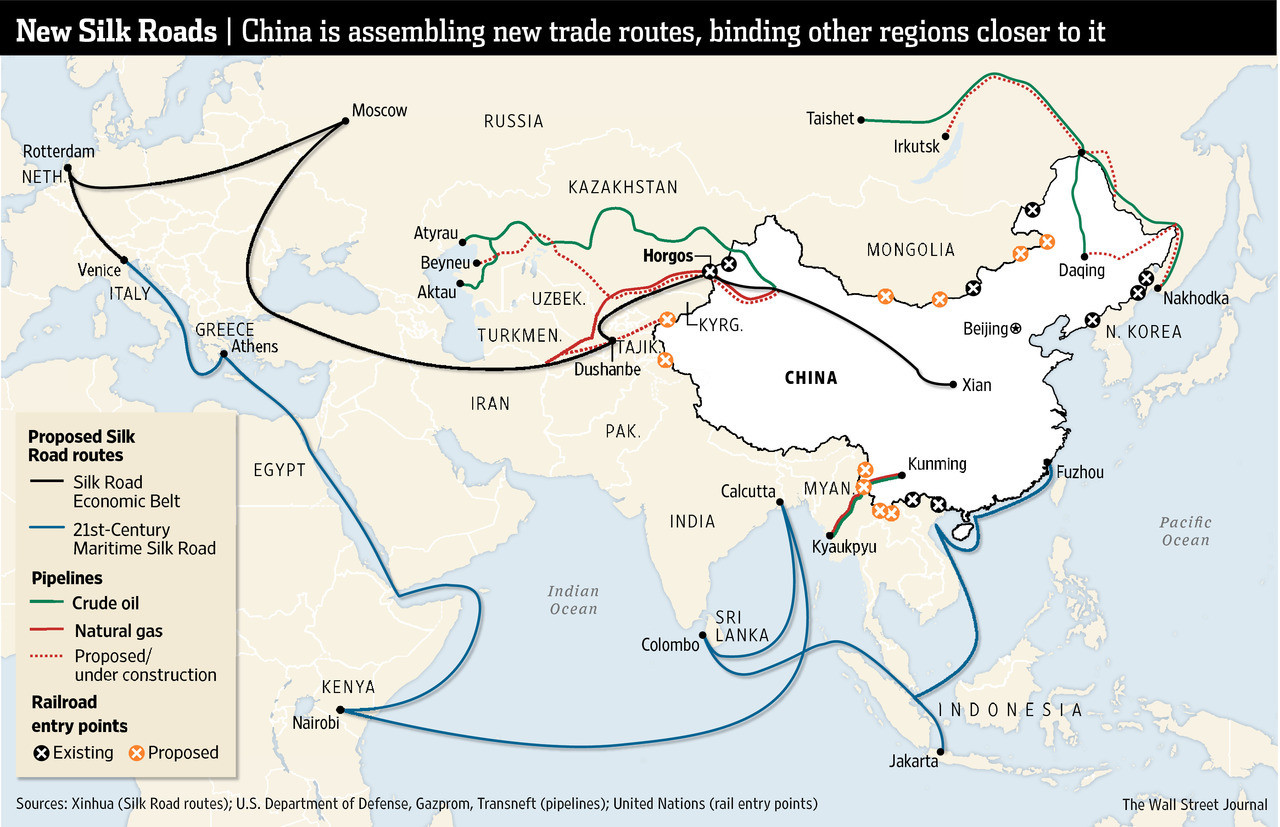
A map illustrating China's silk road economic belt and the 21st century maritime silk road, or the so-called "One Belt, One Road" megaproject, is displayed at the Asian Financial Forum in Hong Kong, China January 18, 2016.
It's proved costly and controversial. So why is China reopening its trade route with the west?
Image: REUTERS/Bobby Yip
Written by
Anna Bruce-Lockhart, Editor, World Economic Forum
Sunday 26 June 2016
Written by
Anna Bruce-Lockhart Editor, World Economic Forum
Published
Sunday 26 June 2016
Share
China is reviving the historic Silk Road trade route that runs between its own borders and Europe. Announced in 2013 by President Xi Jinping, the idea is that two new trade corridors – one overland, the other by sea – will connect the country with its neighbours in the west: Central Asia, the Middle East and Europe.
The project has proved expensive and controversial. So why is China doing it?
Image: Wall Street Journal
There are strong commercial and geopolitical forces at play here, first among which is China’s vast industrial overcapacity – mainly in steel manufacturing and heavy equipment – for which the new trade route would serve as an outlet. As China’s domestic market slows down, opening new trade markets could go a long way towards keeping the national economy buoyant.
Hoping to lift the value of cross-border trade to $2.5 trillion within a decade, President Xi Jinping has channelled nearly $1 trillion of government money into the project. He’s also encouraging state-owned enterprises and financial institutions to invest in infrastructure and construction abroad.
“It is not an economic project, it is a geopolitical project — and it is very strategic,” Nadège Rolland, an analyst at the National Bureau for Asian Research, told foreignpolicy.com. He's not alone in suspecting China of a tactical repositioning in the global economy; it's clear that relationships with the ASEAN region, Central Asia and European countries stand to improve significantly if China directs more of its capital into developing infrastructure overseas.
Moreover, by striking up economic and cultural partnerships with other countries, China cements its status as a dominant player in world affairs.
"We will support the One Belt, One Road project," said President of the Asian Infrastructure Investment Bank, Jin Liquin. "But before we spend shareholders' money, which is really the taxpayers' money, we have three requirements." The new trade route should be promote growth, be socially acceptable and be environmentally friendly.

Friday, July 8, 2016

US CUSTOMS AND BREXIT

Validity of Customs Decisions in Light of Brexit

Monday, July 11, 2016
Sandler, Travis & Rosenberg Trade Report
The legal uncertainty caused by the United Kingdom’s recent referendum vote to withdraw from the European Union will impact all businesses involved in trading with the UK. While the UK is still part of the EU for the moment, the future of EU-UK relations remains unknown and there is a growing sense that the terms to be negotiated for the UK’s withdrawal may be less than favourable. Economic operators should therefore exercise caution in relying on customs decisions made in the UK and/or EU so as to anticipate and mitigate potential risks.
Click here to read the full article. Click here to access the Brexit Information Hub for the latest information on what Brexit means for international traders.

FREIGHT FORWARDING

Should freight forwarding be more like Orbitz and Travelocity? If yes, what holds it back?


INVENTORY IS NOT A PROBLEM

Too many retailers and manufacturers wrongly treat inventory--too much, too little-- as a problem. It is a symptom of a problem.


CONTAINER LINES ARE BACK TO RATE CUTTING

Things are good. Insanity has returned to container line pricing.


'Crazy' bout of price-cutting to gain marketshare reignites Asia-Europe rates war


Loaded and Securely Tied Containers
The enigma of ocean carrier commercial pricing was in evidence again this week as Asia-Europe container spot rates took a tumble, despite ships reportedly running full on the headhaul route.
The Shanghai Containerized Freight Index (SCFI) recorded a 22.7% fall in rates to North Europe, which declined by $274 to $932 per teu.
And for Mediterranean ports, there was an 18.9% dip on the week, taking $221 per teu off rates down to $951.
One carrier source told The Loadstar that after the massive 77% hike in Asia-North Europe spot rates last week, “everybody simply went crazy”, seizing the opportunity to grab more market share by a frenzied and brief spell of rate discounting.
He said the rate cutting had now eased and he expected spot rates on the trade would continue their recovery path next week, ahead of another raft of price hikes.
Industry analysts say there appears to be “no logic” for shipping lines to give revenue away in a quest for more cargo when westbound sailings are running at over 90% full, and containers are being rolled-over every week.
Nevertheless, having an abundance of containers available to ship helps load a vessel to capacity, given that planners have more options to fill unused slots from the range of light, medium and heavy boxes in the export stack.
Moreover, there is some evidence that the container lines are now being much more selective on shut-out cargo than hitherto, and are also focusing on loading higher-revenue-paying containers in order to maximise the voyage result.
Indeed, forwarders are increasingly concerned at, what one described to The Loadstar recently as, the “cavalier attitude” of some carriers towards honouring booking commitments, thus throwing a spanner in the works of many a supply chain calculation.
Selectively shutting-out heavy or low-paying cargo is nothing new in shipping; it is always a question of whether the carrier can manage the commercial consequences.
But with an abundance of cargo during the peak season, carriers may not be too concerned at losing business – they no doubt believe they can regain it as and when it suits them. And it is also the reason why it is now the turn of the carriers to shy away from signing long-term contracts that give space commitments to shippers.
However, the problem for the container lines will come after the peak season months, and – or when – demand slows in Europe, bringing renewed downward pressure on spot rates.


SOLAS VGM

Can we have a reality check on VGM--actual compliance vs container lines looking the other way!


Wednesday, July 6, 2016

DOES LEAN NEED TO BE REVISED?

In a world dealing with the Amazon effect, does traditional lean need an update? It's now about outside the 4 walls.


Tuesday, July 5, 2016

MORE SIGNS OF CHINA ECONOMY SLOWING

Weak China Data Point to Slowing Growth

China’s manufacturing data for June suggest economic growth slowed in the second quarter


A worker cuts steel for an offshore natural gas platform at a subsidiary of China Offshore Oil Engineering Co. Ltd. in Qingdao, in eastern China's Shandong province, on June 1, 2016. ENLARGE
A worker cuts steel for an offshore natural gas platform at a subsidiary of China Offshore Oil Engineering Co. Ltd. in Qingdao, in eastern China's Shandong province, on June 1, 2016. Photo: Associated Press
BEIJING—In a first look at China’s economic performance in June, two gauges of manufacturing activity weakened as factories continued to battle overcapacity, slower growth and rising debt.
The figures released Friday, combined with other recent soft data, suggest second-quarter growth to be announced later this month was slower than the first quarter’s 6.7%, economists said. The first-quarter figure was already the slowest since the global financial crisis.
China’s National Bureau of Statistics reported Friday that the official manufacturing purchasing managers index edged down to 50.0 in June, the level that separates expansion from contraction, from 50.1 in May. The June figure, which follows three consecutive months of expansion, matched a median forecast by 13 economists polled by The Wall Street Journal.
Separately, Caixin Media Co. and research firm Markit Economics reported Fridaythat the Caixin manufacturing PMI, a competing private measure, came in at 48.6 in June, down from May’s 49.2 level. This was the fastest decline in four months and the 16th consecutive month the index has languished in contraction. Economists say the Caixin PMI tends to better reflect the outlook of smaller private companies, while the official PMI more closely tracks larger state-owned companies.
Official subindexes measuring new orders and raw material inventory both declined in June from May, while the official production subindex improved slightly, the statistics bureau said. China’s official nonmanufacturing PMI, which measures activity in the service sector and which was also released Friday, rose to 53.7 in June from 53.1 in May.

“The sentiment and outlook for the economy are still quite gloomy,” said Commerzbank AG economist Zhou Hao, adding that Britain’s vote to leave the European Union has added to the uncertainty. “I expect a little more stimulus, not a big one, but maybe a bit more fiscal spending.”
China’s second-quarter growth rate is likely to come in at around 6.5% and economic growth in the second half could fall below that, Mr. Zhou said. He gives China an 80% chance of hitting its full-year growth target of between 6.5% and 7%.
In another sign of recent weakness, rail freight volume fell by over 7% year on year during the first five months of 2016. The number of bankruptcies rose 52.5% year on year in the first quarter to 1,028, according to the Supreme People’s Court.
And despite an announcement by Beijing of a cut in production capacity in the steel and coal industries by about 10% over the next several years, the manufacturing sector continues to battle industrial overcapacity, deflation and rising debt levels, economists said.
“Overall, economic conditions in the second quarter were considerably weaker than in the first quarter, meaning there has been no easing of the downward pressure on growth,” said Zhengsheng Zhong, an analyst at CEBM Group Ltd. in a statement. “The government must strengthen its proactive fiscal policy while continuing to follow prudent monetary policy.”
But there were also some recent signs of stability after Beijing stepped-up fiscal and monetary stimulus. Year-over-year electricity consumption rose in May, as did auto sales.
Companies on the front line say they are feeling the pinch. Anhui Funan County Xiangfa Arts Co., which makes furniture, ornaments and garden equipment for export in the southeastern city of Huanggang, said production and sales are softer this year and likely to remain that way as demand continues to slip. And despite the weakening economy, labor costs continue to rise as the government tries to bolster consumption and fewer people enter the workforce as China’s population ages.
“Worker’s salaries have gone up 30% in a year,” said Wang Dengwei, general manager at Anhui Funan, which has annual revenues of about 100 million yuan ($15 million) and depends on skilled workers to make many of its handicrafts. “That is really squeezing profits.”
Industrial profits grew 6.4% year on year in the first five months of this year, down from 6.5% during the January-April period, according to official data, while profits at state-owned companies fell 9.6% year on year in January-May compared with 8.4% during January-April.
Write to Mark Magnier at mark.magnier@wsj.com

REPORT--CONTAINER SHIPPING HITS BOTTOM

Container Shipping Hits Bottom -Drewry

But the recovery will be long and hard for shipping lines battered by record-low rates, the industry consultants say.


Some shipping lines are charging less to transport a container than the cost of the journey, a sign Drewry says the market is about to rebound. ENLARGE
Some shipping lines are charging less to transport a container than the cost of the journey, a sign Drewry says the market is about to rebound. Photo: HDR, Inc.
The container-shipping industry may have finally hit bottom, a consulting firm that tracks the sector says. Now shipping lines hammered by sliding prices will need to weather a climb back to profitability that could take years.
The rate charged to transport a 40-foot container from Asia to the U.S. West Coast has fallen to an all-time low of $800, less than a third of the price in 2010, according to Drewry, the U.K.-based shipping consultants.
That’s as low as rates are likely to go, Drewry says. Demand remains tepid, and too many ships are available to carry cargo. But rates have fallen so far that shipping lines can’t cover their costs. They’ll either cut capacity, or the weaker carriers will go out of business, gradually bringing the market back into balance, said Drewry analyst Neil Dekker.
“The shipping lines were all driving rates down on pretty much all trade routes to either get more or hang on to market share. Logic dictates there’s only so long you can do that because at the end of the day, you’ll go bust,” Mr. Dekker said. “They’ve seen that the market share war, which has led to incredible rate destruction – they can’t keep doing that.”
Some shipping alliances – which band together to share space on large, chartered container ships – have already begun to cut capacity on certain trade routes, including services that bring goods from Asia to Northern Europe and from Asia to the east coast of South America. The result has been modest gains in the rates they are able to charge shippers.
Many publicly-traded shipping lines, including Maersk Line and CMA CGM SA have posted losses in recent quarters, meaning that their total costs outweighed revenue from customers. However, some shipping lines are now being forced to charge less to transport containers than the cost of the journey, usually among the final stages of any downturn, Drewry said.
But Drewry said shipping lines face a long rebound. For 2017, the firm predicts that global freight rates will rise by about 8%, a small gain compared with the declines of 2015 and 2016. Demand growth is expected to grow by less than 2% this year, Mr. Dekker said.
Other parts of the freight transportation industry are stabilizing after steep price declines as well. The Internet Truckstop, which measures loads and prices for business between freight brokers and trucking companies, said rates rose an average of 0.5% a week over the four weeks ending June 25, though prices were still 11.7% behind the same period a year ago. DAT Solutions, another so-called load board, said rates in its weekly index held steady through most of June.


Write to Robbie Whelan at robbie.whelan@wsj.com

CONSOLIDATION WITH INDIA'S E-COMMERCE

The consolidation of India’s overcrowded e-commerce sector has begun

Quartz india
Quartz india
In India’s e-commerce industry, it isn’t just the customers who are scouting for deals.

Online fashion retailer Jabong is the latest industry player said to be shopping around the idea of a merger. According to The Economic Times, the Rocket Internet-backed company is in talks with several competitors, including China’s Alibaba Group, Kishore Biyani-led Future Group, and Myntra, which is owned by Flipkart. Snapdeal and Aditya Birla Group also may make a bid for Jabong, according to a report in the newspaper Mint.

“We, unfortunately, cannot comment on market rumours and speculative reports,” Sanjeev Mohanty, CEO and managing director of Jabong, said in a statement. “As we have said earlier we are always open to engaging with strategic partners in our local markets to build a strong alliance and fully capitalise the business to profitability.”

The buzz about Jabong’s acquisition is not new. Back in November 2014, press reports suggested that Amazon was in talks to acquire the company for $1.2 billion as it looked to counter Flipkart’s acquisition of Myntra. But the talks reportedly failed because the two companies could not reach a consensus on Jabong’s valuation.
In 2014, Jabong was among the two top online fashion retailers in India, competing closely with Myntra. However, over the last two years, the company has lost steam. While Myntra continued to get a massive funding infusion from Flipkart, Jabong could not manage to attract funds to support its business.

What appears to be happening at Jabong is not an isolated incident.

Amid a poor investment environment, mergers and acquisitions among India’s tech startups have picked up in 2016, and e-commerce is leading the wave.

In the last three months, for example, online fashion retailer Voonik acquired four startups, and Craftsvilla, an online store for ethnic products, made three acquisitions.

“This trend will continue because the big players are now scouting for companies that complement their offerings or add new segments that could help them with incremental growth,” said Rishabh Lawania, ‎founder of Delhi-based startup research firm Xeler8. “Also, given the current tight funding scenario, smaller startups won’t be able to raise funds like they could do before. So they will have open themselves to acquisitions.”

Some of the top M&A deals in the B2C startup space in 2016 include:

MonthTargetAcquirerDeal size (in $ million)
JanuaryCommonFloorQuickr200
JanuaryAllGoVisteon30
JanuaryShifuPaytm8
FebruaryBagittodayZee22
MarchEasyPosZopper5
AprilFabFurnishFuture Group2.5
AprilAdOnStreamMuses Marketing2
MayLawin1MyeCA.in0.6

Monday, July 4, 2016

HONG KONG PORT AND DECLINING TRADE

Hong Kong, Founded on Its Harbor, Comes to Terms With Declining Trade

Port Area Ahead Of Hong Kong's Trade Figures
Bloomberg/Getty ImagesWorkers unload steel rods from a ship at Kwai Tsing Container Terminals in Hong Kong on Dec. 7, 2015

Falling volumes and regional competition have brought about an existentialist crisis in a city identified, above all, with its famous harbor

Chan Yum-wo did not know anything about the maritime industry when he signed up as a dockworker in Hong Kong in 1994. But that did not matter to the former primary-school teacher. A friend told him there was good money to be made at the container terminals, and Chan needed a secure job with a steady paycheck. He had a new family to support.
It was a busy time for the city’s fabled Victoria Harbour. In fact, Hong Kong’s port was then the busiest in the world, according to statistics from Hong Kong’s Marine Department. In the year Chan joined, the equivalent of 11 million 20-ft. containers from nearly 200,000 vessels passed through the port as they crisscrossed the seas.
“We created a miracle,” says Chan, who became a founder and leader of the Union of Hong Kong Dockers.
But those days have passed. Today Chan is 65 years old, his hair is white and he hasn’t worked at the docks since February, when the number of containers moving through the terminals declined for the 18th straight month. The port that was the center of the world when Chan joined is now ranked fifth.
“It’s a sunset industry,” he says.
Hong Kong’s port is suffering, creating an existential crisis for the city. As anyone who has been on its waters will tell you, Hong Kong, an archipelago of 263 islands, is its harbor.
“I think the thing we forget is that Hong Kong only exists because of the port,” says Richard Wesley, the director of the Hong Kong Maritime Museum.
But pressure from new terminals in southern China and shifting manufacturing supply chains have taken a toll. As the port handles fewer containers each month, the workers hired by subcontractors that supply labor to the terminals are receiving fewer calls to work.
Some people remain optimistic about the port’s future and rightly point out that fifth in the world is still a tremendous slot. They speak about the developments taking place that will hopefully bring business back to the port, or at least plug the drain. Few, however, expect a return to the top.
More than 150 years ago, there were some who doubted Hong Kong’s maritime potential altogether. Lord Palmerston, the British Foreign Secretary when the Union Jack was raised over Hong Kong in 1841, was unimpressed by the island. “It will never be a mart for trade,” he famously said, calling it a “barren rock.”
But naval eyes could see that the sheltered, deep-water harbor that lay between the craggy islets lay was superbly suited to the new steel, steam-driven ships that were replacing wooden vessels, Wesley explains.
The port grew steadily under British rule through the 19th and 20th century, flourishing particularly after the creation of the People’s Republic of China following World War II. Hong Kong was well positioned to serve the shipping needs of the growing country, Wesley says, being of China but not part of it. By the late 1960s, it was clear a modern facility was needed. The advent of containerization created demands for volume and efficiency. So traditional operations were transferred to a purpose-built facility on reclaimed land in a northwestern part of Kowloon. Its first berths opened in 1972, ready to receive the world’s trade.
Today the facility, known as Kwai Tsing Container Terminals, is Hong Kong’s main port. It squeezes into a square mile nine terminals with 24 berths that offer more than 4.7 mile of frontage, according to statistics from the Hong Kong Marine Department. The site can be overwhelming. Steel containers — 8 ft. tall, 40 ft. long — are piled five, six, sometimes seven high and arranged into blocks, and the blocks are stretched into rows. Above these rows loom multistory logistics centers, grey from pollution, which are in turn dwarfed by red cranes with arms reaching skyward, then the towers and cables of a nearby suspension bridge, and finally, in the distance, mountains.
Like the sea, the vast arena constantly rolls and shifts. From the perimeter, you can watch cranes move containers from ship to shore to stack and back again, while a continuous flow of trucks emits an endless rumble and leave the air heavy with exhaust. The cycle is ceaseless.
The overall volume of containers loaded and unloaded at a port each year is called throughput and is measured in 20 ft. equivalent unit (TEU) containers, the standard of the industry. Between 2000 and 2010 throughput at Hong Kong’s port rose steadily, despite a precipitous drop following the 2008 financial crisis. But after peaking in 2011 at 24 million TEU containers, the volume fell steadily over the next four years to about 20 million in 2015, with six months of double-digit decline last year, according to statistics from the Hong Kong Maritime and Port Board.
Former challengers Shanghai and Singapore are now easily the world’s first and second busiest ports, each handling more than 150% of Hong Kong’s yearly throughput. The future does not look bright either. Deutsche Bank predicted that Hong Kong’s throughput could fall from 30% to 50% over the next decade, according to a 2015 study cited by industry publication the Journal of Commerce.
The effects of this loss have come ashore. Dockworkers used to work in teams of nine but now have to settle with seven, Chan says. Those who remain on the docks have grown older, as the younger generation turns to industries with better pay. In 1994, workers hired by subcontractors earned about $195 per 24-hour shift. Twenty-two years later, that pay has only increased by $25 — and that was only after a 40-day dockworker strike in 2013 stalled operations at the port and sparked a series of rises.
Dock workers march during a strike at Kwai Chung container terminal in Hong Kong
Tyrone Siu—Reuters Dockworkers march during a strike at Kwai Chung container terminal, which is operated by Hong Kong International Terminals Ltd., in Hong Kong on March 29, 2013
At the same time, falling throughput means less work to go around. One docker tells TIME that, by his estimate, calls for jobs had fallen by as much as 30% over the past nine months. Many of his former co-workers, he said, were looking for construction jobs.
Tsz-leung Yip, an associate professor in the Department of Logistics and Maritime Studies at Hong Kong Polytechnic University, explains that container throughput has dwindled as manufacturing has moved out of southern China and into Southeast Asia. This trend has cut down the volume of profitable direct shipment, Yip says, leaving Hong Kong rely on the less lucrative business of transshipment, where containers are stored at the port temporarily as they are shifted from one ship to the next. Rival ports in Shenzhen that lurk just across the boarder on the Pearl River Delta only make matters worse.
“I personally don’t expect the business will come back,” Yip says.
To maintain competitiveness in the coming years, Hong Kong’s government has agreed to release extra parcels of land and berths at Kwai Tsing, as well as to a reorganization of the existing facility, said Jessie Chung, chair of the Hong Kong Container Terminal Operators Association. Although the changes are “not very substantial,” she says, it is “the right direction to move in” because it will offer more breathing room for transshipment cargo.
“All we hope is we will stop the decrease or even have some throughput increase,” she says. But hope is in limited supply on Hong Kong’s docksides these days.

CONFIRMING LETTERS OF CREDIT

Should you Confirm your Letter of Credits?


When selling internationally, a company may find it hard to protect their sale through the use of trade credit insurance and receivable puts. A more common way is confirming a letter of credit, particularly on export sales.
What does Confirmed mean?
In layman’s terms, when issuing an L/C, the Buyers Bank stands in the place of the buyer in a foreign or domestic country.  This is not always an acceptable risk. This is where confirmation comes in.  A confirmed irrevocable letter of credit enables a domestic bank to stand in place of the buyers bank, with permission from the buyers bank, creating a post-shipment domestic transaction with respect to the seller, and a pre-shipment foreign transaction with respect to the buyer and the buyer’s bank.
Many corporations adopt a policy that all export letters of credit (“L/Cs”) received must be confirmed by their banker(s) in order to cover the payment and country risks of the L/C issuing banks. In a prior survey I conducted, companies still confirm L/Cs, with 65% doing so for many of their L/Cs, and only 13% not doing for any of their L/Cs. It is not always apparent who pays for the confirmation fees, depending again on the trading relationship. Many times, larger companies will build both the confirmation charges and estimated discrepancy handling charges into the pricing if they have the leverage to do so.  Other companies don’t have that luxury and hence the resistance felt by some suppliers in certain markets.  Many times the driver for companies is to turn a recourse or Collection payment into a non recourse source of funding, particularly for large dollar sales.
Click here to download your copy of the 2016 State of Supply Chain Finance Industry
Here’s some advice before you embark on confirming a Letter of credit and incur potentially unnecessary fees:
  • Start by using S&P and Fitch Ratings to guide your decision process
  • Be more proactive asking your bankers questions. We found companies have questions and could be much smarter in how they use confirmations (egs. Do Vietnam banks open confirmed L/Cs, what clauses to include for sight Confirmations in China, can you confirm in Venezuela, etc.)
  • If companies look at it from a pure commercial risk perspective, typical markets needing confirmation need to be divided into two parts – state-owned companies in emerging markets and non-state owned companies. Many times, the real challenges come with the state-owned companies. They have the ability to pay, but sometimes they seem to erect barriers to prompt payment. Typically the state owned companies will require payment by L/C but will often include irrational, irrelevant, impossible or contradictory clauses in the L/Cs which will then take time and money to resolve.   This is especially true with the commodity volatility we have seen over the last few years.
  • Confirmation requests in certain markets such as China are the exception, and knowledgeable companies either don’t insist or pursue silent confirmations. In India, many times an L/C is required as a means for buyers to finance the goods. A confirmation request there may not be necessary (although there is high documentation risk).
Ultimately, get smart how your bankers approach confirmation, what markets they will cover and will not, and what risk mitigating techniques they require from the overseas issuing Banks. This is especially imperative as more banks reduce their correspondent Bank relationships due to onerous compliance requirements.  So second and third tier banks in Pakistan, or Cambodia or the Middle East may now find it harder to do business.