Monday, September 12, 2016

HANJIN AND CONTAINER LINE INDUSTRY

dreamstime_l_32182724
The crisis that gripped the global financial markets in the summer of 1997 saw a few Asian countries, including South Korea, take centre stage. It led, one year later, to the default of Russia and the spectacular collapse of John Meriwether’s Long-Term Capital Management, which was one of the biggest financial dramas of the 1990s.
Trembles in Asia have returned with a vengeance, and reverberate around the world. As a disordered bankruptcy of Hanjin Shipping becomes increasingly likely, we are reminded how badly contagion risk could impact global economies if it is not properly managed.
The problem goes to the heart of capitalism, globalisation and the concept of moral hazard – although bankers and shipping executives still hope somebody will come to the rescue.
There are significant differences between now and 20 years ago, of course, but, sadly perhaps, central banks and politicians seem to have run out of ammunition, and the demise of Hanjin Shipping could end up being a leading indicator for financial markets.
Hopefully, I am wrong.
1997-credit crunch
1997 was not the end of world. Despite the subsequent tech bubble, whose powerful effects fully materialised at the beginning of the 21st century, the turmoil that characterised the late 1990s was broadly contained. One reason was that fiscal policies were less constrained in the post-Clinton era; another that the risk-free rate hovered several basis points above today’s levels, leaving central banks with plenty of room for manoeuvre, up to 2014 or so.
While Alan Greenspan and his crew did nothing to prevent the financial and economic disaster that began to unfold in mid-2007 – keeping interest rates far too low for far too long, among other things, while supporting banking deregulation – the trading and the financial worlds continue to pay a hefty price to this day, with stagnation being the chief enemy more than two decades after the first cracks in Asia had become apparent.
2009-2016: container shipping a leading indicator?
Only a few days from the eighth anniversary of Lehman Brothers’ demise – which contributed to pushing down stock markets to multi-year lows in March 2009, when the current bull market started – the wind blowing from Asia heralds a cold winter, with an Indian Summer spoiled by talk of a likely gradual tightening from the US Federal Reserve.
This matters a lot, because the apparently inevitable bankruptcy of Hanjin Shipping recently gave a short-term boost to freight rates, but it similarly indicates that a financial/economic meltdown could be around the corner.
As with banks in the liquidity crisis that began in mid-2007, the asset side of the balance sheet of container shipping companies reveals highly illiquid assets. These are not junk loans and mortgages, but are represented by a slew of vessels whose value should reflect that of scrap metal, in most cases, if they were liquidated overnight.
The abnormally low current-to-fixed assets ratio in container shipping has traditionally been seen as a side issue by the main operators, which have paid little attention to the way they managed shareholders’ funds. Now, this is not only a big problem for shipowners and their funding plans, but forwarders are not immune and neither are box terminal operators and shippers.
Who is to blame?
You can blame China, of course. However, as the debate about the devaluation of the yuan rages on – this is one of the biggest systemic risks embedded in the financial markets, spurred by depressed commodity prices – the spotlight in shipping circles and around the globe is on the fallout of Hanjin Shipping, which is raising peanuts from the affiliates of its parent, Hanjin Group, in order to prevent contagion along the supply chain.
News today is a tad more encouraging, yet a couple of hundred million dollars is small change, given that the line likely needs more than half a billion dollars to pay port fees and other dues to sort out the mess it finds itself in. The value of Hanjin Shipping is meaningless once its fixed assets are booked at liquidation value.
To some, the decision the South Korean government will ultimately have to take with regard to Hanjin Shipping appears obvious: a restructured Hyundai Merchant Marine (HMM) will emerge as a sole winner, with the blessing of politicians. State-owned lenders didn’t bow to Hanjin’s requests, but played a key role in the bail-out of HMM, which will become its national champion.
However, this situation could have dire consequences on confidence in global trades of consumer goods, and comes at a critical time, given the upcoming holiday season.
Incidentally, aside from Hanjin, Germany’s Hapag-Lloyd is also sailing against the wind, France’s CMA CGM needs to cut costs to stay the course and some of the Japanese box liners could be forced to merge.
While most container shipping companies remain in the red, Maersk Line, the world’s largest player in the industry, is expected to announce a restructuring any day, but there are clear signs of unease in the stock markets.
The Dow Jones Industrial Average dropped almost 400 points on Friday, while other US indexes were also hammered. Futures prices point to another challenging session today in North America, while trading was particularly challenging in Asia and Europe earlier today.
Will the bankruptcy of Hanjin be a turning point?
The first-ever losses Maersk Line reported, in early 2010 for fiscal 2009, lagged the bottom of the financial markets, but back then monetary and fiscal policies had about a (lost) decade to manifest themselves, propping up asset prices, with bonds and equities benefiting the most. These two asset classes have been sending us diverging signals for some time.
Moreover, the soaring levels of bad debt in some key European countries remains a near-insurmountable problem if large cash calls do not ensue, while the number of sour shipping loans still sitting on a few banks’ balance sheets is disturbing.
Undoubtedly, the fortunes of the container shipping industry and consumer spending – now the main global driver of value – are intimately tied: as growth remains fragile around the globe, the events that have characterised the major liners worldwide this year indicate that my worst-case scenario for interest rates could play out by the end of 2017.

HANJIN BANKRUPTCY--WHY DID SO MANY IGNORE THE SIGNS?

Hanjin bankruptcy--many ignored strong signs of what was and is happening to container lines. Investors. Shippers. Ports. Media. Why?


HANJIN COLLAPSE--BY THE NUMBERS

Factbox: Hanjin Shipping collapse - by numbers


The collapse of South Korea's Hanjin Shipping (117930.KS), the world's seventh-largest container carrier, has disrupted global trade networks and driven up freight rates.Following are some of the key numbers:

$14 billion - the estimated value of cargo tied up globally as Hanjin ships idle outside ports that won't let them in.
400,000 - the estimated number of containers stranded on Hanjin ships.
8,300 - estimated number of cargo owners involved.
$38 million - the value of goods, mostly TVs and appliances, that Samsung Electronics (005930.KS) alone has said it has stuck aboard two Hanjin ships.
$1,700 - the average cost to move goods in 40-ft containers from the U.S. West Coast to Asia - up from $788 in May.
7.8 percent - of the trans-Pacific trade volume for the U.S. market carried by Hanjin.
141 - the number of ships Hanjin has (97 container ships, 44 bulk carriers). More than half are blocked from docking, and four have been seized as of Sept 11.
$5.5 billion - Hanjin's debts (6.1 trillion won) as of end-June.
$293 million - Hanjin's market value (322.5 billion won) - down by around a third in the past two weeks.
$226 million (249 billion won) - Hanjin's operating loss in April-June, on revenue of $1.3 billion (1.43 trillion won)
Source: Hanjin Shipping, Korea Shipowners' Association, Thomson Reuters Eikon data
(Compiled by Joyce Lee in SEOUL; Editing by Ian Geoghegan)

Sunday, September 11, 2016

DOING OMNICHANNEL FROM STORES?????

Must challenge points in this.  Up-to-date inventory--based on? Employees both sell and ship? Versus "lower" shipping costs? Glosses over real omnichannel supply chain issues.


Omnichannel Retailers Use Supply Chain to Lower Shipping Costs

samuel zellerOmnichannel retailers struggle with shipping costs: Charge too much, and customers flee, but charge too little and retailers are left with dwindling profits.
Customers who abandon shopping carts online, it often is a signal that your shipping costs are too high. It’s not uncommon: According to Baymard Institute, 67.45% of carts are abandoned. And CPC Strategy found retailers lose $18 billion annually due to shopping cart abandonment.
But lowering shipping costs while providing products at reasonable prices is a difficult balancing act. Solvency depends on making a decent margin on goods, but if prices are perceived as too high (because shipping is built into that figure), then the retailer risks having languishing product.
Customers often want free — not just inexpensive —shipping, delivered within a day or two. Many retailers struggle mightily trying to satisfy those demands. But for smaller chains, who may have less purchasing power with their suppliers, fulfilling that request is often impossible.
However, an omnichannel program with a strong foundation can help retailers identify where products are within their supply chains, and deliver them most efficiently to their customers. Ship-to-store capabilities help companies sell inventory wherever it resides, whether that’s at a store in Sacramento, CA, or Newark, DE.  Once located, retailers can direct the product to a store where it’s needed, or have it shipped directly to a customer. Not only does that “save the sale” but it also nurtures customer loyalty.
A ship-from-store strategy can reduce delivery costs for the customer because the retailer uses its own outlets as fulfillment centers. The closest location takes delivery of the product and ships it to the customer. The retailer must use its supply chain in the most efficient manner possible, and that includes being diligent about inventory visibility. Retailers must have up-to-date inventory count at all locations to reduce delivery costs.
It is a practical solution to the “delivery problem” to fulfill an order from a customer who lives virtually around the corner from a retail store with product from that location rather than have it shipped from a distribution center hundreds of miles away. Being able to take a close look at inventory lets retailers provide customers the delivery they want, without sacrificing good business sense.

Friday, September 9, 2016

KOREAN AIR DELAYS HANJIN FUNDING DECISION

Korean Air Lines delays decision on funding plan for Hanjin Shipping

[SEOUL] Korean Air Lines, the biggest shareholder in Hanjin Shipping, on Friday delayed a decision on a funding plan for the troubled carrier.
"We haven't reached a conclusion at today's board meeting, so we have decided to discuss the matter again tomorrow," a spokesman for the airline said.
Hanjin's parent firm, Hanjin Group, earlier pledged to raise 100 billion won (S$121.22 million) in funds to help rescue cargo, which is stranded at sea following the failure of the world's seventh-largest container carrier.
REUTERS

Thursday, September 8, 2016

RISK AVERSION

Has the corporate obsession with risk aversion actually created bigger risk? On the company's future!


CHINA'S CROSS-BORDER E-COMMERCE ISSUES

China’s cross-border e-commerce trade facing uncertainties amid government regulation

PUBLISHED : Thursday, 08 September, 2016, 4:15pm
UPDATED : Thursday, 08 September, 2016, 10:29pm
One in five online Chinese shoppers made a purchase on cross-border e-commerce platforms last year, twice as many as in 2014, but tighter tax and customs regulations signal that the flourishing industry has reached an inflection point, a recent study said.
Dubbed Haitao in Chinese, the 120 billion yuan in cross-border online trade propelled by demand for global brands and facilitated by an explosion of online marketplaces in China is now plagued by policy uncertainties over tax, product safety and logistics issues, according to a report issued Thursday by consultancy Oliver Wyman.
The latest twist in the outlook of the burgeoning online business comes amid an exploding consumer sector in China, which a top government think tank estimates will generate sales topping 50 trillion yuan in the next five years from 30 trillion yuan in 2015.
ADVERTISEMENT
More than 40 per cent of the 50 trillion yuan would come from e-commerce, according to a separate report jointy released by the Chinese Academy of Social Sciences(CASS) and Hong Kong-based Fung Business Intelligence Centre.
“Chinese consumers are probably the most informed and digitalised in the world,” said Wai-Chan Chan, a partner with Oliver Wyman. “As Chinese consumers travel abroad, they are increasingly aware of offline prices around the world.”
The number of Chinese holidaymakers travelling overseas this year is expected to increase by 11.5 per cent to 133 million, according to the China Outbound Tourism Research Institute, which also forecasts the growth trajectory in the coming five to 10 years to remain steady.
The Oliver Wyman study said that Haitao, which comprises more than 3 per cent of total e-commerce transactions in China, had reached a “tipping point” where regulatory hurdles should drive the players to come up with a “Plan B”.
There has been a wave of shutdowns of department stores across China, which is still gaining momentum
Chinese Academy of Social Sciences
In April Beijing introduced a new tax regime for cross-border e commerce, making mainland online shoppers liable for 70 per cent of a slew of VAT taxes previously applied only to wholesalers.
In the same month, the State Council ordered the country’s customs and tax agencies, among others, to step up inspections of parcels shipped to China not only for content but also to ensure taxes and tariffs were properly paid.
Beijing also made it clear that the action was aimed at cracking down on counterfeit goods imports through internet channels.
“The future of the channel now seems unclear to many of the players…. These regulations cover a wide range of topics, including tax, product safety, manufacturing standards and logistics,”the Oliver Wyman report said. “Some of the newly announced regulations are not fully defined and are subject to further elaboration, leaving substantial room for speculation.”
While cross-border e-commerce faces regulatory roadblocks, the CASS report maintains that economic headwinds, Chinese consumers’ shift to online as well as overexpansion in commercial properties has spelt doom for the country’s brick-and-mortar department stores.
“There has been a wave of shutdowns of department stores across China, which is still gaining momentum,” the CASS study said, calling for the government to step in to prevent systemic risks posed by the collapses.

CHINA'S SILK ROAD

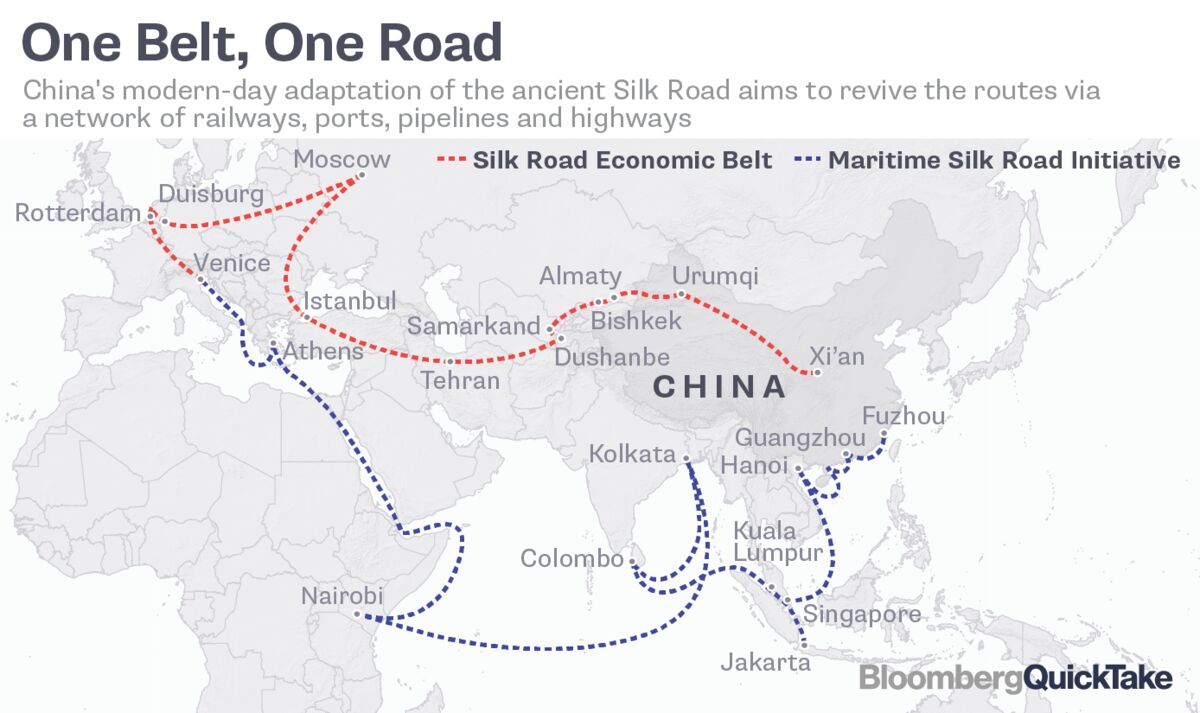
China's Silk Road

Ancient Routes Carry a Nation's Influence West

By | Updated Sep 8, 2016 1:05 AM UTC
The name Silk Road conjures images of caravans, desert steppes and adventurers like Marco Polo navigating the ancient trading routes connecting China with Central Asia, the Middle East, Africa and Europe. China’s modern-day adaptation aims to revive those routes via a network of railways, ports, pipelines and highways. President Xi Jinping champions his pet project as a means to spur development, goodwill and economic integration, as well as finding markets for China's over-producing factories. Critics — both along and beyond the Silk Road routes — are wary of China's push to spread its influence further west. 

THE SITUATION

Xi has outlined a decades-long drive to grease the wheels of trade with infrastructure projects costing tens (or perhaps even hundreds) of billions of dollars. Typical plans include the development of ports in Malaysia and Tanzania or highways in Pakistan and Tajikistan. The vision goes beyond better connections; China is also encouraging its companies to invest in industrial projects such as utilities. To bankroll these ambitions, the government created the $40 billion Silk Road Fund in 2014; already, it's backed a dam in Pakistan and a liquefied natural gas operation in Russia. Other funding sources include the BRICS Development Bank and China's $100 billion Asian Infrastructure Investment Bank (AIIB) — an alternative to the World Bank that the U.S. and Japan initially pilloried for lacking the same standards of governance. Xi says more than 30 countries have signed formal agreements with China and 20-plus are cooperating on plans such as railways and nuclear power. China stands to gain not just by putting to work its underused industrial capacity and excess production of materials like steel, but also by promoting greater use of its currency. Partner nations are weighing economic benefits against an increasingly dominant superpower's demands. A deal for a rail project in Thailand collapsed because local officials were unwilling to grant China's request for property rights .
Source: Bloomberg

THE BACKGROUND

Xi first raised the idea of a modern Silk Road in 2013 and went on to refer to it as "One Belt, One Road," combining his plans for an overland "belt" and maritime "road." Although the original trading routes were established more than 2,000 years ago, the Silk Road's name — derived from the delicate fabric highly prized by the Roman elite — was coined only in the 19th century by a German geographer. In its heyday, paper, gunpowder, porcelain and spices were transported to the west; horses, woolen rugs and blankets, gold, silver and glass made the return journey. Just as monks used the routes to spread Buddhism, the modern Silk Road is not just about commerce: China floats visions of film festivals and book fairs, scholarships and jointly run schools, as well as cruise ships plying the maritime lanes via Southeast Asia and Africa.

THE ARGUMENT

China emphasizes the Silk Road's role in boosting industrialization in the developing nations sandwiched between East and West. Economists say the initiative has the potential to stimulate Asian and global economic growth. Risks include stoking graft in a region beset by corruption (the Kyrgyz prime minister was forced to resign in 2016 over a contract award to a Chinese company) and long-shot developments turning into white elephants (like the world's emptiest international airport in Sri Lanka). Certain projects — particularly costly overland routes — may simply not be economically viable. Critics point to China's increasingly assertive military, particularly in Asia's waters, and question whether the development of ports might presage the establishment of naval bases (the so-called “string of pearls” theory). China's rejection of a tribunal ruling on its South China Sea claims has also raised questions about its regard for the international rule of law. Part of the plan's success may depend on the attitudes of Russia (initially skeptical but increasingly warm) and India, which is closely watching developments in Pakistan. There's also the question of how long China will be prepared to forge ahead with costly overseas investment when growth at home is slowing.

AMAZON SLASHES DELIVERY TIMES

Big wake-up call for omnichannel retailers who have not transformed their supply chains. LTD's white paper at its website presents the New Supply Chain for Omnichannel and More.


Amazon Cuts Delivery Times in Threat to Alibaba, EBay, Wish.com


  • Small items commonly shipped from China now Prime eligible
  • Amazon looks to beat rival marketplaces on speed of delivery

Amazon.com Inc. is speeding the delivery of USB cables, smartphone screen protectors, cosmetics and other small, flat items in its continuing push against rival marketplaces that help overseas manufacturers and suppliers sell directly to U.S. shoppers.
The Seattle-based company notified merchants Wednesday that such items would now be delivered to Amazon Prime members within five business days, down from eight previously, according to an e-mail obtained by Bloomberg. That makes Amazon delivery of small, inexpensive items from China, for example, much faster than the two weeks to 30 days it can take using marketplaces owned by Alibaba Group Holding Ltd., EBay Inc. and Wish.com.
Amazon wants quick delivery, which has helped it dominate online shopping in the U.S., to further differentiate itself from competitors in cross-border e-commerce. U.S. online shoppers will spend about $30 billion this year on cross-border transactions, a 10 percent increase from 2015, with China the leading source of goods purchased, according to a February report by EMarketer. An Amazon spokesman declined to comment on the delivery changes.
The move comes two months after Amazon slashed shipping fees it charges merchants who sell items through the company’s Fulfillment By Amazon Small and Light program, introduced last year to offer shoppers free shipping with no minimum order size on thousands of popular small items, most of which cost $10 or less.
“I expect the small and light program to explode in volume,” said Neil Ackerman, a former Amazon executive who started the program and now heads e-commerce initiatives at Mondelez International. “Wish.com and other marketplaces won’t be able to compete with Amazon when it comes to speed or customer service.”
Amazon continues to refine the small and light delivery system to blunt competition from rival marketplaces that help Chinese merchants ship directly to U.S. shoppers through the ePacket program. EPacket is an agreement between the U.S. Postal Service and China Post that provides Chinese merchants cheap access to U.S. shoppers on small packages weighing as much as 4.4 pounds (1.7 kilograms).

What Amazon's 'Prime Air' Means for FedEx and UPS

Wednesday, September 7, 2016

IT LOOKS LIKE QVC IS STRUGGLING AGAINST E-COMMERCE

Laying off all those warehouse people is not good. Is QVC another victim of e-commerce? What should they do?


QVC cuts 100 jobs at West Chester HQ

QVC has cut another 100 people at its West Chester headquarters, as it expands operations on the West Coast.

QVC, the home-shopping video network controlled by communications investor John Malone, has cut another 100 people at its West Chester headquarters, as it expands operations on the West Coast.
The company, which employs 17,000 worldwide, including 2,600 at its Studio Park TV broadcasting and office complex, plus 1,400 at its Lancaster County warehouse, made the "difficult decision to reorganize" West Chester business units with fewer workers, spokeswoman Colleen Rooney told me.
Even as it reorganizes in West Chester, QVC says it is adding jobs elsewhere. "For example, we opened our new West Coast Distribution Center [in Ontario, Calif.] last week with 160 positions, and we’ll add hundreds more as the center expands."
Last month, QVC spooked investors when CEO Michael George acknowledged a mysterious summer drop in woman's clothing sales, around the time Amazon.com ramped up its fashion sales offerings. QVC shares fell below $21 for the first time since 2013 and have stayed close to that level. George is scheduled to address a Goldman Sachs investor conference tomorrow.
The company laid off another 100 Pennsylvania workers in January, plus 147 last year, as it consolidated some warehouse operations to South Carolina. It also moved foreign warehousing from more expensive West European locations to Poland.
QVC acquired Seattle-based mobile-shopping pioneer Zulily for $2.4 billion last year in hopes of attracting younger customers. The deal includes Zulily's Lehigh Valley warehouse.
The combined company says it is now "reimagining shopping, entertainment and community as one" and "innovating our structure to make sure we have the right resources and expertise to drive innovation and growth."
"Impacted" workers who lose their jobs will be offered severance and job search help, Rooney said.

Monday, September 5, 2016

INTERNATIONAL TRADE IS GROWING AGAIN

This could be very good news – international trade is growing again after two years of decline

A ship is loaded with containers at Sydney's Port Botany container terminal March 4, 2013. Australia's trade deficit shrank by much more than expected in February to its smallest in 14 months thanks to higher prices for resource exports.
This halts two years of declining figures.
Image: REUTERS/David Gray
International trade grew in the second quarter of 2016, according to OECD figures.
This halts two years of declining figures. It's a rare piece of good news for the global economy, and comes days before the G20 leaders' summit takes place in China.
Trade among members of the G20, a group of 19 countries and the European Union which represents 85% of global GDP, grew modestly in the second quarter of this year, the first increase since early 2014.
Exports
Combined exports in the G20 rose by 1.5% in the second quarter of 2016, after falling for the previous seven quarters.
 G20 total international export merchandise trade
However, there were some marked differences between individual countries. Exports grew in almost all G20 economies except Argentina, Canada and China. India, South Africa and Turkey all registered growth of more than 5%.
Imports
Combined imports rose by 2.0%, after eight consecutive quarterly falls. All G20 economies recorded growth in imports in the second quarter of 2016, except Argentina, France, India, Indonesia, and Mexico, who all registered slight falls. Russia's imports fell by 5.0%.
China recorded the highest growth in imports at 6.6% growth in the second quarter, but levels remain lower than in 2014.
 G20 total international import merchandise trade
The G20 comprises 19 individual countries: Argentina, Australia, Brazil, Canada, China, France, Germany, India, Indonesia, Italy, Japan, Mexico, Russia, Saudi Arabia, South Africa, South Korea, Turkey, the United Kingdom, the United States of America; as well as the European Union.
Global trade in focus
International trade is an important driver of economic and corporate growth. This map shows just how much of that trade is driven by the movement of goods via shipping.
Constructed using 250 million data points, the map, made by data visualization company Kiln, shows the movements of the world's commercial shipping fleet in 2012.
The red lines represent tankers shipping oil around the world. The blue lines represent raw materials such as iron ore and coal, and the yellow lines represent container ships carrying finished goods.
These tens of thousands of ships, travelling across our seas every day, drive global trade and the economy.
The G20
Whilst the international trade figures represent a glimmer of hope for growth in the global economy, they remain significantly below the post-crisis highs seen between 2011 and 2014.
Maintaining the Momentum of World Economic Recovery is a key theme at this year's G20 summit.
World leaders will gather this weekend in Hangzhou, a city of about 6 million people southwest of Shanghai. It is the first time that China has hosted the event, now in its 11th year.
The G20 plays a significant role in shaping the fortunes of the world economy and is the premier forum for international economic cooperation. The group represents 84% of the world economy, 79% of world trade and 65% of the world population.
The G20 Leaders’ process was established after a joint EU-US initiative back in 2008 to tackle the global financial crisis.

BAD SITUATION IN OCEAN SHIPPING

Bad loans to shipping

That sinking feeling

Banks continue to count the cost of shipping’s troubles


TOO many ships, too little trade. On August 31st Hanjin Shipping, South Korea’s biggest container carrier and the seventh-largest in the world, filed for receivership, after five years of losses and another deficit in the first half of 2016. Hanjin was holed by shipping’s prolonged global slump, the product of vast overcapacity and slow trade growth. Its creditors, led by state-owned Korea Development Bank (KDB), have had enough.
Shipping’s malaise is both broad and deep. An earnings index compiled by Clarksons, a research firm, covering the main types of vessel—bulk carriers, container ships, tankers and gas transporters—reached a 25-year low in mid-August. The average for the first half of 2016 was 30% down, year on year, and 80% below the peak of December 2007. Stephen Gordon of Clarksons adds that new orders at shipyards are the lowest in 30 years.
As KDB’s loss of patience shows, the industry’s troubles hurt lenders as well as shippers. According to Petrofin, another research group, Asian banks have expanded their shipping loans in recent years. With China’s economy slowing and world trade in the doldrums, they may soon regret that. For their part, European banks have already been tossed this way and that since the financial crisis of 2007-08. Some, notably Landesbanken—public-sector, regional wholesale banks—in northern Germany, are still counting the cost.
Advertisement

German banks, traditionally strong in shipping, were eager lenders before the crisis, happily putting up 70% of a vessel’s cost—and even the rest, before borrowers raised the equity. Then the storm broke: Petrofin calculates that between 2010 and 2015 leading German lenders slashed their shipping books from $154 billion to $91 billion. In 2012 Commerzbank, the country’s second-largest lender, decided to quit altogether. Its portfolio has since dwindled from €19 billion ($24 billion) to €8 billion.
On August 31st Bremer Landesbank, from the city-state of Bremen, announced loan-loss provisions, mainly for shipping, of €449m—over one-fifth of its equity at the end of 2015—and reported a first-half loss of €384m. At €6.5 billion, its shipping portfolio is around 30% of its loan book. Bremer LB will not be allowed to sink. NORD/LB, its neighbour, which already owns 54.8%, is taking it over fully. The deal values the state government’s 41.2% stake at €262m—far below its worth when Bremen boosted its holding in 2012.
NORD/LB itself is far from shipshape. It recently reported a first-half loss of €406m, thanks to further loss provisions on marine loans. It plans to cut its shipping book, €19 billion at the end of 2015, to €12 billion-14 billion. Last month it agreed to sell $1.5 billion of loans to KKR, a private-equity firm, and an unnamed sovereign-wealth fund. A third lender, HSH Nordbank, is seaworthy largely thanks to guarantees, covering €10 billion of loans, from the states of Hamburg and Schleswig-Holstein. The guarantees were cut to €7 billion in 2011, but increased in 2013 when that proved premature. In May the European Commission approved the reinstated aid, provided that the bank’s core operations were sold. This is due by 2018.
Some are confident of steering through choppy waters. Besides KKR, Berenberg, a Hamburg bank, is talking to institutional investors about buying (well-performing) loans. Not everyone is seasick.

Friday, September 2, 2016

UPS IS RAISING RATES

UPS to Raise Service Rates by 4.9% on Average

Parcel delivery company says increases will help pay for system upgrades, expansion

A United Parcel Service Inc. driver starts his truck after making a delivery in Cumming, Ga. ENLARGE
A United Parcel Service Inc. driver starts his truck after making a delivery in Cumming, Ga. Photo: Associated Press
Starting Sept. 19, it will cost 4.9% more on average to ship a package through United Parcel Service Inc. UPS 0.08 % ’s freight service.
A similar 4.9% increase will go into effect across UPS’s other services as of Dec. 26, the Atlanta-based company said Thursday.
UPS said the higher rates, roughly in line with increases carried out in previous years, would help pay for system upgrades and expansion.
In July, UPS reported a 3.2% increase in second-quarter profit, driven in part by its e-commerce delivery segment, but cautioned its traditional stronghold of business-to-business shipments would remain weaker due to lower exports tied to the strength of the U.S. dollar and an inventory overhang among industrial customers.
Write to Maria Armental at maria.armental@wsj.com

FREIGHT FORWARDERS AND HANJIN

Forwarders/NVOs/OTIs took advantage of the container line financial chaos.  So why is everyone supposed to feel sorry for them with Hanjin?


REAL ESTATE AND RETAIL

What is the real estate impact of unneeded retail stores and retail warehouses?


LOGISTICS VS SUPPLY CHAIN PERFORMANCE

Does focusing on logistics functions and costs interfere with real supply chain performance?


Thursday, September 1, 2016

FEDEX AND UPS WITH E-COMMERCE

Have FedEx and UPS misplayed e-commerce where their growths trails growth of online sales?