Friday, March 10, 2017

IS EXPEDITORS A TAKEOVER TARGET?

Analysis: Expeditors the next takeover target for DP-DHL?

expeditors2
As I ponder whether any freight forwarder – apart from Panalpina – could be poised for a change of ownership, more evidence emerges in the annual results of market leader DP-DHL that major asset-light logistics operators have arrived at a critical juncture.
Market conditions
Oh yes, I am looking forward to sifting through the full financial results of the German behemoth next week. But briefly, it is important to flag certain warning signs in its trading update, dated 8 March, which shows a falling top line for DHL Global Forwarding (DGF) – down €1.15bn to €13bn, or 8.2% year-on-year – by far the largest fall since the €3bn top-line drop DGF experienced in the aftermath of the credit crunch, in 2009.
Management in Bonn is bullish, as DGF’s annual operating income rose swiftly, hitting €287m (compared with 2015’s €181m loss), but the impressive yearly surge was only due to heavy one-off charges (basically, the now-infamous bill for the New Forwarding Environment IT disaster) that pushed the unit into the red in 2015. In fact, DGF’s Ebit still remains shockingly below previous years’ levels (2014: €293m; 2013: €478m; 2012: €514m; 2011: €440m).
Bad mix
Undoubtedly, these are difficult times for most players. Currency headwinds are combining with a deflationary, more competitive environment, which is also characterised by lower oil prices – “Oil breaks below $50 a barrel for first time in 2017” was a recent headline in MarketWatch.
This does not help global logistics operators, so it is almost inevitable to speculate that cash-rich forwarders could attract interest from third parties, particularly rivals that are bigger and more diversified.
Expeditors International of Washington, one of the healthiest and most profitable companies in the field, has been high on my radar since it reported annual results at the end of last month. I am now publicly speculating: could it actually be a target for DGF?
A deal would cost $15bn for its equity, I reckon, implying a 50% premium to its current market cap – it is certainly do-able, but what are the odds?
Crown jewel
Expeditors is a crown jewel in the freight forwarding universe, but I gather certain figures sent shivers down the spine of some value investors and its stock has essentially been flat since it disclosed its financial performance on 21 February.
(To learn more, about the company’s business lines and prospects, please read this comprehensive article here.)
After a solid 2016, which came in the wake of another record year in terms of financial performance, Expeditors has some serious decisions to make. It trails the market leaders by some distance, both in air and sea freight, and the odds have to be long that the gap will narrow significantly anytime soon.
Organic growth is hard to come by, while it is also debatable whether the recent appointment of Philip Coughlin to the newly created post of chief strategy officer could end up being a defining moment. A company veteran with 31 years’ experience, Mr Coughlin fits with the track record of Expeditors, which leaves me – and you are entitled to feel the same – underwhelmed when it comes to creative capital deployment strategies.
Expeditors appoints Philip Coughlin
Source: Expeditors
Urgency to act
Traditionally shy in deal-making, the US forwarder has a tendency to avoid the M&A spotlight. However, a soaring gross cash pile, a conservative payout ratio and an under-levered balance sheet could prove to be more of a headache more than balm if it is serious about delivering incremental returns to shareholders this year and next.
On the one hand, a timid stance on corporate strategy is understandable, given the sluggish business cycle and a lowly forward dividend yield in the 1.4%-1.5% area, which ought to be preserved, if not raised; but there remains downside risk to bullish projections for earnings per share and revenues, as the table below suggests.
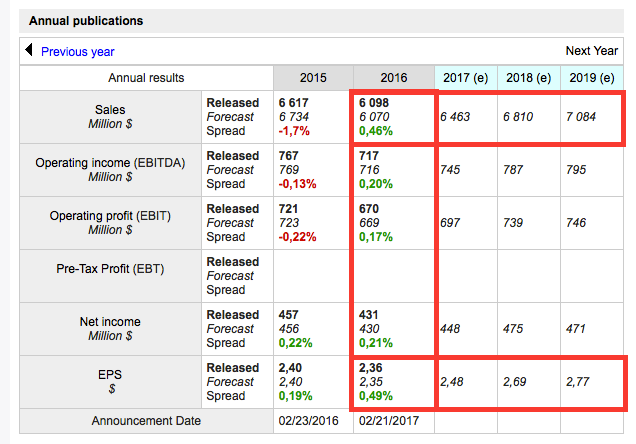
Expeditors revenue projections
Source: 4-traders.com
On the other hand, it can be argued that more urgency to open talks with possible partners or to chase deals should be felt in Seattle. After all, air freight revenue dropped 10.4% to $2.45bn in 2016, while ocean freight and services sales plunged 12.6% to $1.9bn – only its oft-overlooked customs brokerage arm bucking the trend, having recorded rising sales above US inflation to $1.7bn.
On an aggregate, gross and reported basis, the top line fell 7.8% year-on-year to $6bn, broadly in line with consensus estimates, while net revenue, a non-GAAP measure of performance, declined 1% to $2.16bn – which is the first time non-GAAP sales have dropped since 2012, when the fall to $1.83bn was more pronounced, admittedly.
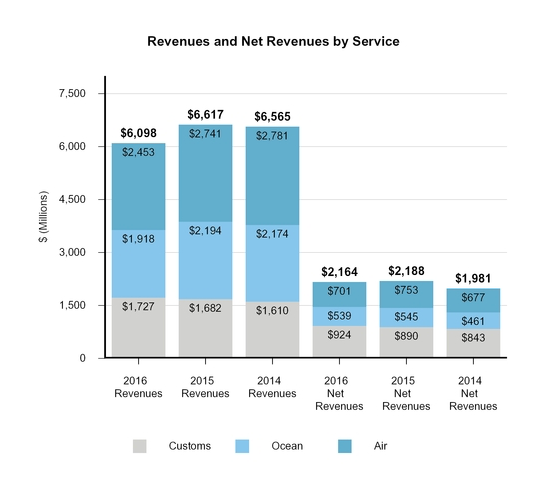
Expeditors' revenues by services
Source: Expeditors’ 10k form
Cost-management leader
Expeditors stands out in the industry when it comes to costs management – direct and indirect expenses that are essential for its daily activities fell 7.9%, slightly outpacing the drop in gross revenues. Its largest cost, associated with ocean freight and ocean services, plunged 16.3% to $1.75bn, followed by an 11.8% decline to $1.37bn in air freight expenses.
Essentially, it is doing what sea freight leader Kuehne + Nagel does best: shoring up gross profit, while other operating costs are on the rise.
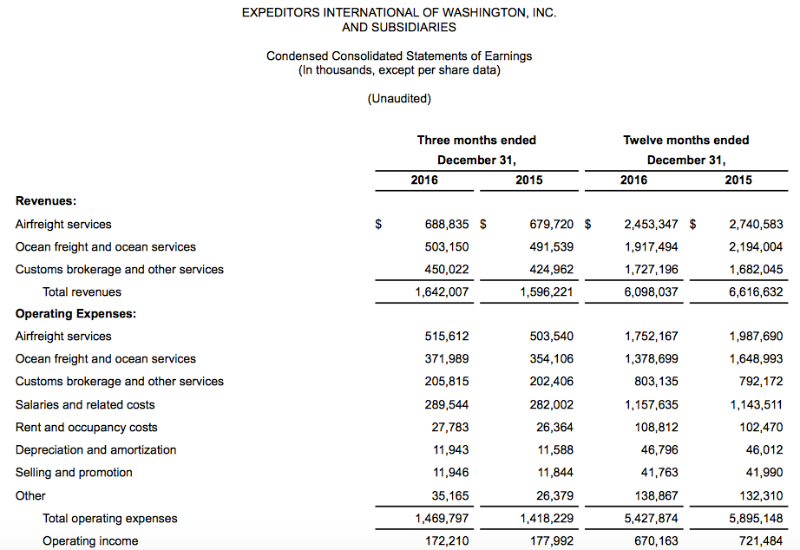
Expeditors' costs
Source: Expeditors’ 10k form
But if this is the way forward, what alternatives does it have at its disposal?
On the fence
At operating level, its income was only $51m lower year-on-year, and although that fall represents 35% of annual dividends, and 15% of the cash spent on buybacks, it wasn’t material as Expeditors continues to manage working capital carefully.
A significant drop in cash inflows from receivables was fully offset by a drop in payables, and the amount of cash flow it churned out from operations was only $35m lower on a comparable basis – which again indicates near-flawless execution and financial ability.
Why on earth, then, would it need a partner or a takeover?
One for UPS
Shareholders enjoyed 16.6% pre-tax returns excluding dividends, but crucially, its five-year performance on a relative basis is less enticing.
Expeditors' returns
Source: Expeditors’ 10k form
For one thing, any incremental stock repurchase financed by cash or new debt will be accretive to earnings, but it will become more expensive given a share price that is less than $1 below its all-time highs. Another problem is that as the future sustainability of global trades is questioned, it might need to sow the seeds now to become more US-centric.

Expeditors' revenue by geography
Source: Expeditors’ 10k form
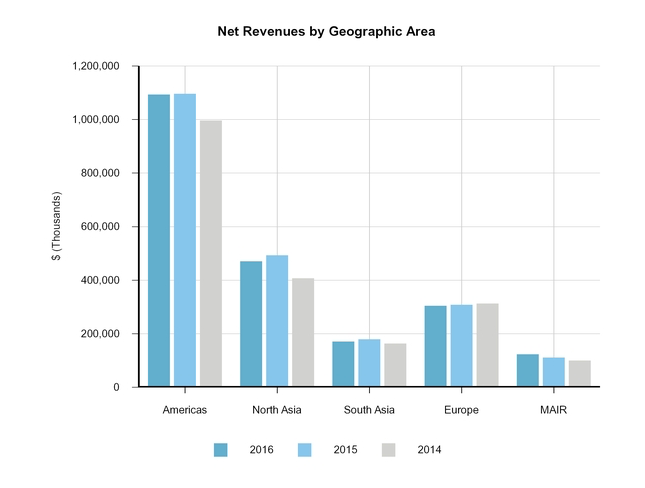
As it pointed out in its latest trading update, “North Asia is our largest export-oriented region and accounted for 37% of revenue, 22% of net revenue and 34% of operating income”, is one obvious attraction – another, for would-be suitors, is that “no single customer accounts for 5% or more of our net revenue”.
More broadly, the recent EU ruling concerning the aborted UPS/TNT merger deal of 2013 reinforces the view of some observers that Europe, where Expeditors also generates meaningful revenue, might again be a place to consider – although admittedly seeking strategic partnerships or deeper ties there does not seem a very smart idea, especially given latest remarks from the European Central Bank‘s chief, and in any case, only circumstantial evidence indicates that DGF would be attracted to Expeditors.
But it would make a lot of sense, in my view, to combine its sea freight activities, and perhaps even its air freight business, with closer rivals, such as DSV, Panalpina, Bolloré or Nippon Express, although the big issue here is that Expeditors would likely be the diner rather than the dinner, given its size.
Finally, to paraphrase the words of a London-based deal-maker, as protectionism prevails and the world becomes a smaller place, a blown-out offer – if one emerges – would have to be crafted by one of the major logistics companies in North America. In that respect, UPS, which has its own problems, could be the ideal acquirer – it ticks all the boxes financially and while its market share in sea freight is almost negligible worldwide, it ranks just outside the top 10 in global air freight.

Thursday, March 9, 2017

IOT E-COMMERCE LOGISTICS LAB IN CHINA

Next-gen logistics lab opens in China


A new innovation lab is primed to benefit one of the top players in China’s e-commerce marketplace.
 
Zebra Technologies, Digital China and Chinese e-commerce giant JD.com, which Walmart owns a 12% stake in, have joined forces to develop a state-of-the art facility entitled the "IoT + E-commerce Logistics Lab.” 
 
Residing at JD.com's pilot warehouse in Beijing's Shunyi district, the lab brings together best practices, resources and talents in logistics management, data collection, mobile computing, machine vision, cloud computing and IoT. 
 
The facility will enable the alliance to research and develop, prototype implementation, test and evaluation, and conduct application demonstrations, all of which will support the creation of next-generation logistics solutions, according to Zebra. 
 
Zebra and channel partner, Digital China, have been long-time collaborators of JD.com. 
 
The retailer already utilizes the partners’ barcode printers and scanners and mobile devices in its warehouses and order fulfillment chain, all of which deliver real-time visibility into its operations. 
 
But now the company is ready to take the next step. Moving forward, lab output will enable JD.com to harness innovative technologies to further boost logistics capabilities, as well as increase enterprise efficiency and productivity — factors it hopes to use to improve its customers’ retail experiences. 
 
On tap for 2017, JD.com plans to improve the productivity of its current picking and packaging operations using mobile devices; increase the visibility of the tens of thousands of trays and cage trolleys used in JD.com's operations; and to seek potential of applications of machine vision and data analytics in the logistics industry.

OCEAN SERVICE CONTRACTS

FMC aside, are container lines ocean service/shipping contracts really contracts?


2017 LOOKS ROCKY FOR CONTAINER LINES

Consolidation Not Enough to Save Box Shippers -Study


March 7, 2017
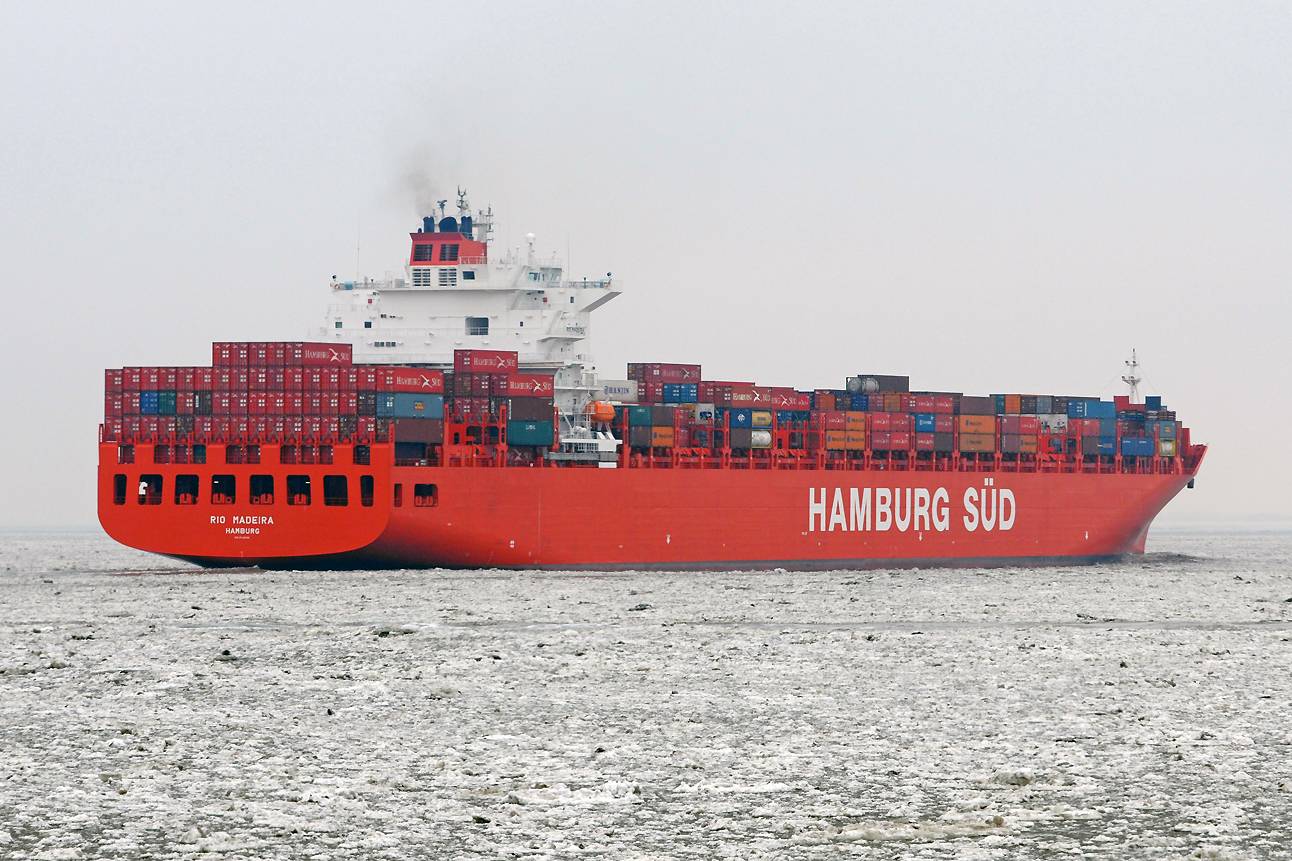
File photo: Hamburg Süd
The outlook for global container carriers remains rocky at the outset of 2017, according to a new study by AlixPartners.
 
Hanjin Shipping Co.’s bankruptcy in 2016 sent shock waves through the industry, while Brexit and the new U.S. administration’s policies threaten to inject further uncertainty into the future of global trade. These stances could reverse policies that have supported the growth of containerization since the 1950s. Going into the important pricing season, companies need to do everything they can to retain the higher rates recently seen.
 
“The industry remains in the midst of major upheaval it’s experienced since the 2008 financial crisis. Carriers need to remain focused on eliminating costs from their core shipping business,” said Esben Christensen, Managing Director at AlixPartners. “While there has been good news recently in rates, the industry still needs to be prepared for continued struggles. The recent consolidation isn’t the cure all for the industry.”
 
Despite the distress the industry continues to experience, hope remains. Rate levels on major East-West trades improved—dramatically in some cases—in the fourth quarter of 2016. Carriers managed to sustain those higher rate levels because of an unusually early Chinese New Year, which should buoy financial results for the fourth quarter. 
 
“Spot rates rose nicely after Hanjin ceased operations, particularly for eastbound transpacific trade lanes,” said Lian Hoon Lim, Managing Director at AlixPartners. “But the boost lasted only a few weeks and rates reverted to the habitual depressed levels we have seen.”
 
Financials remain bleak 
As the shipping industry plows through the doldrums, companies have been searching for solutions to their financial problems. Companies have slimmed operating expenses and reduced capital expenditures, slashing them to $12.4 billion in 2016 from $25.2 billion in 2011. But those efforts may not go far enough. Nearly every key financial indicator worsened from the previous year. Operational cash flow as a percentage of revenue slowed to an anemic 6 percent through the last 12-month period ended September 30, 2016, which is still outpaced by capital expenditures. The industry’s total debt levels, driven by borrowing for M&A activity, have edged back up. Additionally, earnings before interest, taxes, and depreciation (EBIT) margins turned negative in Q3 2016 for the first time in the study’s sample period. This does not bode well for the 2017 calendar year, because the industry usually sees peak volumes during the third quarter.
 
Given the dire situation, it was only a matter of time before a bankruptcy occurred, and it was a big one—in fact, the biggest one since the United States Lines bankruptcy in 1986. Hanjin’s unraveling will likely have profound impacts on the market this year. In fact, spot rates for the eastbound transpacific trade lane, a focus of Hanjin’s network, have nearly doubled since the carrier declared bankruptcy. 
 
Consolidation should continue 
The study says the global container shipping market will likely have a glut in capacity for the foreseeable future. Consolidation is only one way to help solve that problem, but it’s a solution that has been ignored for the past decade. 
 
The pace of M&A activity accelerated through the end of 2016. In late October, the three largest Japanese lines—Nippon Yusen Kabushiki Kaisha (NYUKF) (NYK), Mitsui O.S.K. Lines (MOL) and Kawasaki Kisen Kaisha (“K” Line)—announced their plans to merge in 2017. A few weeks later, the European Commission approved the Hapag-Lloyd-UASC merger, followed by Maersk’s announcement in early December that it was buying German shipping line Hamburg Süd. Carriers that have not been involved in a merger or acquisition are persistently rumored to be the next to do a deal. This wave of consolidation has added increased complexity to shifting carrier alliances.
 
“While the consolidation of the liner industry is considered a positive, it is by no means a panacea for the containership industry and certainly not for the tonnage providers,” said Albert Stein, Managing Director at AlixPartners. “Expect major upheavals in 2017 especially among Greek and German container ship owners, as they find a smaller, if any, market for their ships. All I see now is a move towards building and buying ship types for already overserviced routes which will generate returns that will just about disappoint everybody, particularly in a new global trade environment.”
 
As the reshuffling continues, shippers should carefully reexamine their procurement strategies to ensure supplier diversity, the study concludes. 
 
The 2017 playbook for carriers 
Carriers that have weathered the storm have a difficult task in front of them, but the playbook remains clearly defined: focus on customer and route profitability, reduce operating costs and rationalize the fleet. All of these actions will help support higher rate levels in 2017 and beyond. 
 
Focus on customer and lane profitability 
Carriers should make smart and disciplined commercial decisions around customer and lane profitability. Companies can no longer rely on automatic year-over-year growth. Increased digitization and data utilization is required for companies to understand true costs and revenue potential.
 
Take full advantage of the post-merger integration process
With industry consolidation in full swing, it’s critical that carriers take full advantage of post-merger integration opportunities. Carriers must quickly rightsize their organizations and root out inefficiencies. 
 
Rationalize the global fleet
The global industry fleet size continues to grow, but at a more muted pace. Vessel ordering programs have been slowed or stopped altogether in some cases. Carriers should continue their efforts to trim future vessel orders to be more in line with demand forecasts.
 
The bottom line
Carriers will have to make some hard decisions in 2017. They’ve already taken steps to relieve their financial woes, including slashing expenditures. They must continue to drive down costs through effective post-merger integration and fleet rationalization to bring supply and demand into balance. 
 
Spot rates have improved in the wake of the Hanjin bankruptcy, which carriers must do everything they can to maintain. The carrier community’s ability to drive rate levels higher into future contract negotiations will likely decide whether 2017 will be the turning point the industry desperately needs—or just another bad year in a growing string of losses.
 
 
About the Study
The AlixPartners study Container Shipping Outlook 2017 reviewed the financial results of the world’s 14 publicly-traded ocean container-carriers. Data for 2017 in the study is based on the 12-month-prior period through Sept. 30, 2016.

Tuesday, March 7, 2017

SUPPLY CHAIN SEGMENTATION

Supply Chain Segmentation is a requirement, not an option, for improved performance.

http://www.ltdmgmt.com/segmentation-guide.php

Monday, March 6, 2017

AMAZON AND THE FUTURE OF RETAILING


The Bad News and the Really Bad News for Retailers Fighting Amazon.com

Amazon.com’s ability to sustain its retail growth rate will determine the fate of the rest of the retail industry


Even modest growth at Amazon.com could bruise Target Corp. and other big-box retailers.
Even modest growth at Amazon.com could bruise Target Corp. and other big-box retailers. Photo: Alan Diaz/Associated Press
Here is a thought that should make investors in U.S. retailers tremble: Amazon.com could inflict roughly the same amount of cumulative pain on its competitors over the next three years as it did over two decades as a public company.
Revenue for Amazon’s North America segment—the bulk of its retail business—was $79.8 billion in 2016, marking the second consecutive year of 25% growth. Back in 1997, revenue was below $200 million for its U.S. business. If its now massive North America segment continues to grow at 25% a year, it will take only three more years for Amazon to add another $76 billion in annual revenue. That could deliver a swift blow to a U.S. retail industry, already wilting from Amazon’s aggressive expansion.
Investors must ask how big Amazon’s retail business can get. Its North America sales already represented 3% of 2016 U.S. retail sales, excluding car dealers, gasoline stations, stores selling building and garden materials, food-service vendors and bars and well as grocery stores.
That is still considerably smaller than Wal-Mart Stores, but Amazon won’t be able to put all its bricks-and-mortar competitors out of business. Analysts predict the growth rate for Amazon’s North America segment will slow to 16% in 2018 and decelerate in each of the following years.

Created with Highstock 2.1.5Retail ReckoningAmazon's North America segment sales (millions)THE WALL STREET JOURNALSource: the companyFigures for 2017-2019 assume a 25% growth rate. Figures for 1997-2000 represent Amazon's U.S. retail sales.


Retail ReckoningAmazon's North America segment sales (millions)THE WALL STREET JOURNALSource: the companyFigures for 2017-2019 assume a 25% growth rate. Figures for 1997-2000 represent Amazon's U.S. retail sales.

Created with Highstock 2.1.519982000’02’04’06’08’10’12’14’16’18025,00050,00075,000100,000125,000150,000$175,000

Get financial insights and commentary on global investing from The Wall Street Journal’s Heard on the Street team. Subscribe to the podcast.
Amazon’s shares slumped 22% in 2014 when its North American retail business posted sales growth of only 14% versus the previous year’s 28%. For the rest of retail, however, even modest growth at Amazon could inflict serious pain.
Defending their turf against Amazon already comes at a steep cost. Wal-Mart managed to return to minimal sales growth in fiscal 2016, but operating margins fell to 4.7% from 5% the previous year. Conversely, Target Corp.’s operating margin climbed to 7.2%, but its sales tumbled. Amazon’s own North America operating margins were 3% in 2016.
Target, whose shares fell 12% last Tuesday when it reported fiscal fourth-quarter results, said it will spend $7 billion over the next three years to improve its stores, launch exclusive brands and enhance its digital capabilities while sacrificing $1 billion in potential profit in order to keep prices competitive.
Even when Amazon stops expanding, the damage to industry margins may be irreversible. Online sales come with significantly lower margins, primarily because companies can’t reduce shipping costs by selling more stuff. The willingness of Amazon investors to tolerate low margins has enabled a shift in retail to this high-cost distribution method from having customers visit physical stores.
There are a few retailers that have managed to chart a strategic path away from the Amazon steamroller and their shares should continue to command a premium to peers. For the rest of the industry, Amazon’s growth rate will determine whether things get bad or really bad.

BLOCKCHAIN AND MIDDLEMEN

Supply chains and logistics are full of middlemen.  What will it mean for supply chain management and logistics service providers?

The Promise of Blockchain Is a World Without Middlemen

March 06, 2017

The Promise of Blockchain Is a World Without Middlemen


  •            
mar17-06-block
The blockchain is a revolution that builds on another technical revolution so old that only the more experienced among us remember it: the invention of the database. First created at IBM in 1970, the importance of these relational databases to our everyday lives today cannot be overstated. Literally every aspect of our civilization is now dependent on this abstraction for storing and retrieving data. And now the blockchain is about to revolutionize databases, which will in turn revolutionize literally every aspect of our civilization.
IBM’s database model stood unchanged until about 10 years ago, when the blockchain came into this conservative space with a radical new proposition: What if your database worked like a network — a network that’s shared with everybody in the world, where anyone and anything can connect to it?
Blockchain experts call this “decentralization.” Decentralization offers the promise of nearly friction-free cooperation between members of complex networks that can add value to each other by enabling collaboration without central authorities and middle men.
Let’s start by examining the potential effects of this on an industry that touches all of our lives – banking. The banking industry is filled with shared resources. Consider ATM machines: each machine is owned by a single institution, but accepts cards from a huge network. This sharing requires a complicated management apparatus, mostly provided by VISA. That central entity owns the database and transaction processing layer, which makes everything else possible. If the process of using an ATM had been invented today, with the blockchain as a state-of-the-art database technology as an option, we would most likely not need an administrative entity like VISA to manage the process. Instead, the technology itself would do the heavy lifting of uniting the interests and business processes of the member banks. One can easily imagine a single global blockchain network for managing the interoperability of bank cards. Rather than creating hub-and-spoke methods for organizing our shared resources for mutual advantage, this new technology would provide solutions without any central oversight.
In a world without middle men, things get more efficient in unexpected ways. A 1% transaction fee may not seem like much, but down a 15-step supply chain, it adds up. These kinds of little frictions add just enough drag on the global economy that we’re forced to stick with short supply chains and deals done by the container load, because it’s simply too inefficient to have more links in the supply chain and to work with smaller transactions. The decentralization that blockchain provides would change that, which could have huge possible impacts for economies in the developing world. Any transformation which helps small businesses compete with giants will have major global effects.
Blockchains support the formation of more complex value networks than can otherwise be supported. Normally, transaction costs and other sources of friction associated with having more vendors keeps the number of partners in a value network small. But if locating and locking in partners becomes easier, more comprehensive value networks can become profitable, even for quite small transactions.

Insight Center

Consider the problem that small manufacturers have dealing with giants like Wal-Mart. To keep transaction costs and the costs of carrying each product line down, large companies generally only buy from companies that can service a substantial percentage of their customers. But if the cost of carrying a new product was tiny, a much larger number of small manufacturers might be included in the value network. Amazon carries this approach a long way, with enormous numbers of small vendors selling through the same platform, but the idea carried to its limit is eBay and Craigslist, which bring business right down to the individual level. While it’s hard to imagine a Wal-Mart with the diversity of products offered by Amazon or even eBay, that is the kind of future we are moving into.
As we outline in “The Internet of Agreements,” our paper for the World Government Summit in Dubai, “the incidental complexity involved in business operations could go down by a very large factor, into a domain where a much more complex, contingent and interwoven business environment will emerge. Such an environment might be as different from today’s business environment as container shipping is superior to packing boats by hand.” (Disclosure: I’m the founder of Hexayurt.Capital, a fund which invests in creating the Internet of Agreements.)
For example, imagine the overhead involved in renting temporary furnishings for a house. Right now, this is not a very common practice (particularly for short stays) because of the overhead involved — insurance of each rented item, dozens of vendors, coordination costs getting everything in and out and so on. But if those transactions came down in cost by 90%, it is easy to imagine sites like AirBnB starting to offer custom furniture options in the spaces people are renting. Add robot delivery trucks to that future, and even short stay homes might have custom furnishing options. Making the kind of logistical complexity that is common to (say) theatre productions or aircraft maintenance accessible for smaller events like weddings is just one area where falling transaction costs open up new kinds of business as complex value networks integrate to offer services that simple value networks cannot.
We’re going to see the potential for a trajectory of radical change in all industries. As a society, we’re experiencing a time of unprecedented technological change. It can feel like an insurmountable challenge for leaders to stay on course in such rapidly changing tides.  And yet, with each passing generation, we are acquiring more skill and expertise in navigating a high rate of change, and it is to that expertise that we must now look as the blockchain space unfolds, blossoms, and changes our world.


BLOCKCHAIN AND THE THREE SUPPLY CHAINS

Can blockchain bring together the three supply chains--product, financial, and information?


Wednesday, March 1, 2017

USING STORES FOR E-COMMERCE ORDERS

Stores handling omnichannel orders require more inventory and technology to work well. High cost and risk. What about providing the customer experience?


OMNICHANNEL--RETAIL DUALITY

Traditional thinking by retail execs and by investors is holding back many from transforming to retail  duality of omnichannel and supply chain duality to drive it.