Monday, May 6, 2019

AMAZON ONE-DAY ORDER DELIVERY, NOT JUST SHIPPING

Article, like some retailers, CPG FMCG manufacturers, suppliers, does not understand it is not just shipping. It is the order, aka, the warehouse. Increasing thruput with technology & more locations. All backed by Supply Chain Velocity to restock them.

Amazon can already ship to 72% of US population within a day, this map shows

A closer look at Amazon’s delivery network illustrates why the company is now ready to make one-day shipping the default for its Prime members.
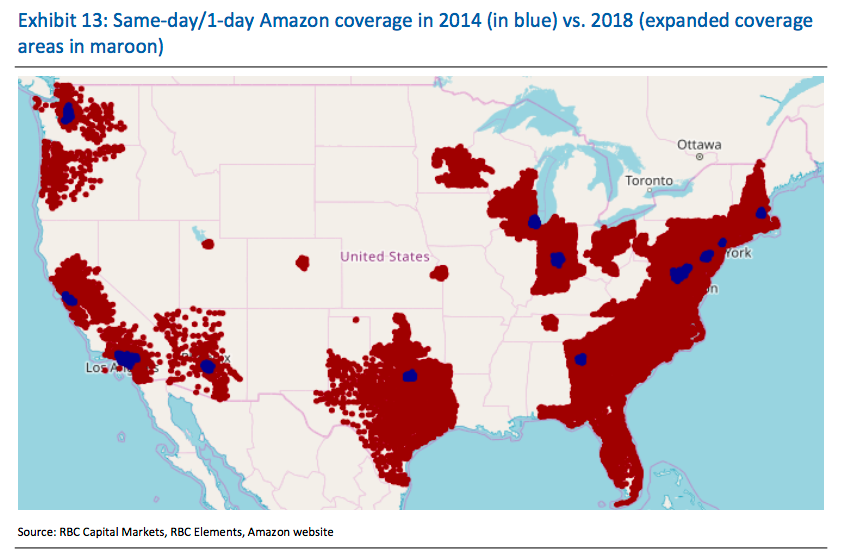
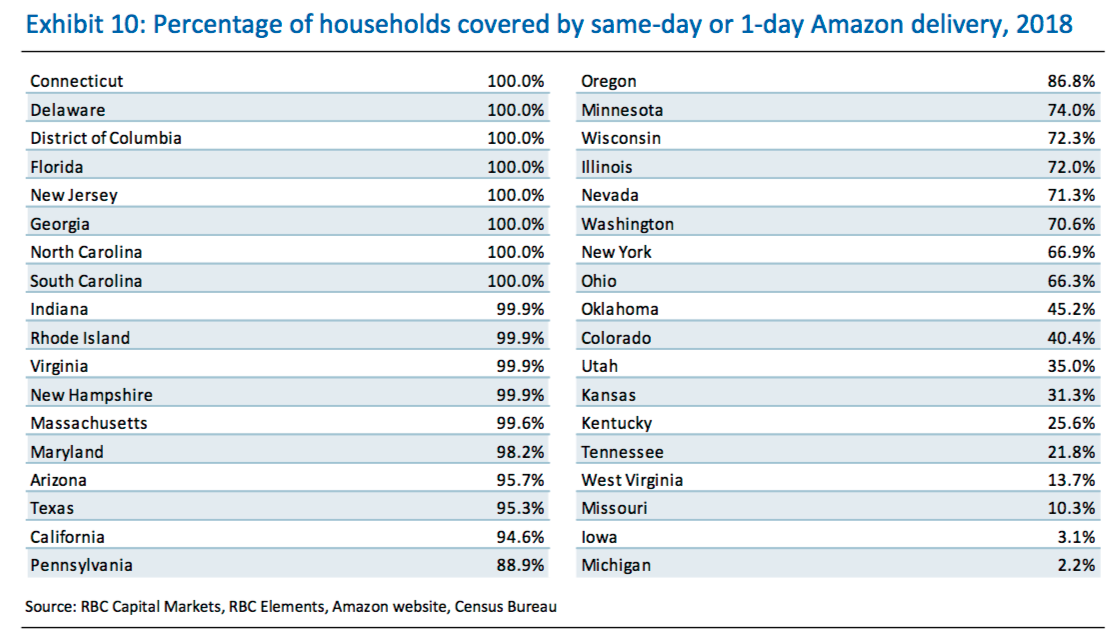
Amazon is already capable of offering same-day and next-day delivery to 72% of the total U.S. population, including almost all of the households (95% or more) in 16 of the wealthiest and most populated states and Washington, D.C., according to a report published in March by RBC Capital Markets.
The vast delivery network is the result of significant investments over the past four years, a period during which Amazon built out fulfillment centers across the country, nearly tripling its U.S. logistics infrastructure, RBC said. Amazon has added roughly double the amount of distribution space Home Depot currently owns.
That means the company has a huge head start in fulfilling i
ts plan laid out in its latest earnings report to shorten the current two-day free shipping plan by one day for Prime members, who pay $119 a year for fast delivery as well as services like unlimited music, access to the video catalog and exclusive deals.
“We see Amazon’s 1-day Prime shipping raising consumer expectations and increasing the cost to compete in e-commerce,” Morgan Stanley analysts wrote in a note after the announcement.
The map below from RBC shows the four-year change in Amazon’s distribution footprint. It already covers most of the coastal cities, as well as Texas and major metropolitan areas in the Midwest.
“While store-level distribution is still the fastest way for a consumer to acquire a product, Amazon’s continued rollout of same-day and next-day delivery capabilities continues to reduce that historical competitive barrier and represents a growing risk to retailers who are too often fighting yesterday’s (2-day) delivery wars,” RBC Capital wrote in the note.
Following the Amazon announcement, RBC said in another report that “the faster you ship, the more people buy.”
Many benefits
One of the biggest reasons people shop at a physical store is because of the immediate need to get a product. By shortening delivery time to one day, Amazon changes that equation. Brian Olsavsky, Amazon’s CFO, said on the first-quarter earnings call that the company is already starting to see “good order trends” after rolling out one-day default shipping to certain areas.
It’s having an impact on the stock market, too. Rival retailers, like Walmart and Target, saw their shares drop following Amazon’s announcement. Most retailers are just now starting to offer two-day shipping and will be forced to spend more on improving their logistics infrastructure to try and keep pace with Amazon.
Even at Amazon, the change won’t come cheap. The company said it’s planning to spend $800 million during this quarter alone to expand one-day shipping. RBC noted that 15 U.S. states still don’t have access to Amazon’s same-day or next-day delivery, so the company will have to spend more heavily to reach those areas.
“While this is a drag on profitability near term, we believe enhancements like this should encourage incremental spending by customers and attract new 
Prime members,” BMO Capital wrote in a note following Amazon’s earnings.
Another benefit is improvements in warehouse efficiency. Since products are shipped faster, more inventory will move in and out of Amazon’s fulfillment centers more quickly.
“The long-term benefit is that turnover will be faster in the warehouse so efficiency can be gained for fulfillment as a percentage of revenues,” Mizuho Securities wrote in a recent note.
https://www.cnbc.com/2019/05/05/amazon-can-already-ship-to-72percent-of-us-population-in-a-day-map-shows.html

Sunday, May 5, 2019

AMAZON STEPPING UP ITS CHALLENGE TO PARCEL DELIVERY FIRMS

Another effort by Amazon with package delivery. Sure to stir up more logistics provider angst. Strategy and execution by logistics firms to prepare and to compete?

Amazon is hiring hundreds more people to start package delivery companies with annual profits up to $300,000

Business Insider

Amazon is planning to hire hundreds more people in the coming months to open and run courier businesses delivering packages for the tech giant.
The company is hiring drivers in roughly 50 US cities, according to job postings. Amazon is also planning to hire hundreds more people into its network of delivery service partners, or DSPs, in the coming months, the company told Business Insider
DSP owners hire and manage teams of delivery drivers for Amazon. The tech giant made a major push to expand its DSP network last year by advertising incentives and annual profits of up to $300,000 to potential applicants.
  • Amazon has since hired more than 100 people into the program, and it's looking to add more. 
  • The program offers a package of incentives, such as discounts on Amazon-branded Mercedes-Benz Sprinter vans, branded uniforms, a fuel program, comprehensive insurance coverage, and more. 
  • The job involves managing a team of 40 to 100 employees and a fleet of up to 40 vans. 
    https://www.businessinsider.com/amazon-delivery-jobs-hiring-drivers-2019-5
    In a brochure describing the opportunity, Amazon says owners can expect annual revenues of $1 million to $4.5 million with profits of $75,000 to $300,000.


AMAZON LOOKS TO ADD TO ITS PARCEL DELIVERY FOR ONE-DAY SERVICE

Amazon getting ready for 1-day Order Delivery Velocity? Aside from a few retailers, what are others, CPG / FMCG manufacturers, suppliers doing to compete in this accelerated reality & its Supply Chain Velocity? Strategy & execution? Amazon is hiring hundreds more people to start package delivery companies with annual profits up to $300,000


Business Insider

Amazon is planning to hire hundreds more people in the coming months to open and run courier businesses delivering packages for the tech giant.
The company is hiring drivers in roughly 50 US cities, according to job postings. Amazon is also planning to hire hundreds more people into its network of delivery service partners, or DSPs, in the coming months, the company told Business Insider
DSP owners hire and manage teams of delivery drivers for Amazon. The tech giant made a major push to expand its DSP network last year by advertising incentives and annual profits of up to $300,000 to potential applicants.
  • Amazon has since hired more than 100 people into the program, and it's looking to add more.
    "We are excited to add hundreds more new small businesses at both existing stations as well as dozens of new delivery stations in the coming months, and we'll add more opportunities for independent contractors to be their own boss and create their own schedules delivering with Amazon Flex," an Amazon spokeswoman said.
    DSPs don't need to have any prior experience in delivery and logistics. To start, they need only a minimum investment of $10,000. People can apply through the company's website. 
The program offers a package of incentives, such as discounts on Amazon-branded Mercedes-Benz Sprinter vans, branded uniforms, a fuel program, comprehensive insurance coverage, and more.
The job involves managing a team of 40 to 100 employees and a fleet of up to 40 vans. 
https://www.businessinsider.com/amazon-delivery-jobs-hiring-drivers-2019-5
In a brochure describing the opportunity, Amazon says owners can expect annual revenues of $1 million to $4.5 million with profits of $75,000 to $300,000.


SUPPLY CHAIN GRANULARITY

Supply Chains, their design, operations, and performance must work both on the granular and aggregate levels. Retailers. Manufacturers. Suppliers. Grocers. SCM


Friday, May 3, 2019

LOGISTICS, SUPPLY CHAIN MANAGEMENT, AND STOCK BUYBACKS

In a time of disruption for retailers, manufacturers, suppliers, grocers, logistics providers, 3PLs, are stock buybacks a misdirection to funding transformation? Are they a bad investment? 


LOGISTICS PROVIDERS STRATEGY AND TAKING THE LEAD

Why aren't logistics providers developing a strategy and execution for the disruption & transformation that crosses both the industry and their customers' Supply Chains? Lead your customers.


SUPPLY CHAIN TIPPING POINT

What will be the trigger, the tipping point, for retailers, manufacturers, suppliers, grocers to actually redesign/transform their Supply Chain to what is required for customer performance? And those that do not transform?


Thursday, May 2, 2019

THE PURPOSE OF SUPPLY CHAINS HAS CHANGED

Retailers. Manufacturers. Suppliers. Grocers. Prior, Supply Chains were meant to hold inventory to feed stores, customers, or factories. Now they are about Velocity, the antithesis of the prior. How are you adapting to the new reality? If you are not, why not?


TRANSFORMING GROCER SUPPLY CHAINS AND DUALITY WITHIN DUALITY

Grocers, their suppliers, and GMA miss a key point. The original Supply Chains had a specific need to fill a specific channel.. The change is omnichannel and trying to fit that old supply chain to do more than it was designed for. Duality of Supply Chains coupled with dual sources of supply chains--grocers and suppliers--requires redesign and transformation. Duality within duality supply chain management.  There are no easy answers to complex problems.


URGENT NEED OF AIR FORCE AND NASA FOR THE NEW SUPPLY CHAIN

This story of NASA & recent one on the F-35 confirm that it is not just retailers & manufacturers who have urgent need for the New Supply Chain. The Air Force and NASA need it, especially with its emphasis on the upstream supply chain where supply & suppliers are. Stop deceptive supply chains.


LOGISTICS PROVIDERS VS AMAZON

Logistics operators--trucking, forwarding / brokerage, and the list goes on-if you are so concerned about Amazon's offering its end-to-end logistics capabilities or parts of it to your customers, what are you doing about it? Strategy and execution plan? Being Amazoned


Wednesday, May 1, 2019

GAME CHANGER: AMAZON'S MOVE TO 1-DAY DELIVERY


AMAZON MOVES TO 1-DAY ORDER DELIVERY

--Game Changer from Retail to Logistics—


Amazon redefined retailing, e-commerce, and boosted omnichannel with free, two-day order delivery.  They did it by transforming supply chain management (SCM) into being the strategic execution and driver to accomplishing it.  With this, Amazon generated chaos and disruption in retail and to CPG and FMCG manufacturers and suppliers.  The term "retail apocalypse" was used to describe store closings and the growth of online selling. 

E-commerce is about convenience.   And power has shifted to the customer.  Before, stores had the power once the person walked in.  Now that person can source his needs with searches and apps—and delivery—while staying home.

What Amazon did was to develop a new reality and how to sell and service it.  Customers have the power now. This contrasts to the prior where retailers had power because customers went to their stores. Not now. Customers can source what they want and buy when they want to have it delivered.

To do the customer delivery that separated them from the online competition, Amazon developed a new supply chain management with end-to-end velocity to drive inventory velocity that is required for order delivery velocity.  They weaponized SCM and integrated into their overall strategy.

Gaining speed included setting up their own forwarding service in China, leasing planes to move products quickly, buying trucks for deliveries, and more.  This meant reverse outsourcing, bringing activities in-house. They have sown seeds of disruption in how supply chains are designed and operate and how logistics can be incorporated as more than separate activities.

Now they planning to spend $800 million to be able to provide 1-day order delivery.  This is a game changer for retailers, e-commerce firms, CPG/FMCG manufacturers and suppliers, supply chain management, and logistics providers and 3PL companies.  Across the gamut, customer expectations are being raised.  Customer service has new meaning. 

What Now? 

If what Amazon did before was considered disruption, this action reconceptualizes selling, customer focus, supply chain management, and logistics.  The challenge then is what is next for retail, e-commerce, CPG/FMCG manufacturers and suppliers.  This test is also with logistics providers and 3PLs as Amazon implements its strategy, as its competitors work to transform, and what is expected with logistics changes to provide velocity.

            Retailers and CPG Manufacturers and Suppliers.  A few retailers have been aggressive in competing with Amazon.  For various reasons, some retailers and FMCG companies do not have an e-commerce omnichannel with using updated supply chain management.  As a result, they have not been aggressive in establishing a robust e-commerce omnichannel capability and have not transformed their supply chains to drive success for the two-day order delivery standard.  This includes manufacturers and suppliers who have not adapted their supply chains to meet the requirements of active retailers and e-commerce firms nor have developed their own strong e-commerce activity.  This group has significant work ahead.

Some of those slow to adapt also define supply chain performance by logistics costs.  They also lamented last mile cost.  These are misdirection.  Logistics costs have little to do with performance.  It should be measured by measures that are company related.  Perhaps the best metric is the Perfect Order, an order/restock that is delivered complete, accurate, and on-time.  It is the ultimate customer-focused result.

First, to develop the needed total supply chain, companies should:

1)     Recognize and understand the complexity and length.

2)     Assess using performance metrics.

3)     Map it.

4)     Segment

5)     Prioritize.

6)     Design, test, and implement the new supply chain.


A little recognized challenge to improving velocity is the presence of logistics providers. Some are placed there with outsourcing. Others are there because of their position--such as ports. All should be evaluated as to need, role, risk and impact on inventory speed.

The above analyses give a picture of where the company is—the starting point for change.  Different views—assess, map, segment, prioritize-- and the insights they provide are important for the design.

Transforming the supply chain raises competitive position and mitigates risk of falling behind for customer sales. In designing, the new end-to-end, omnichannel supply chain with velocity should include these essentials:

·       Integrated Structure—process, technology, organization

·       Time compression.  Excess time both delays inventory movement and creates the need for additional inventory as a buffer—and more working capital

·       Focused on both upstream where supply of supply chain begins and downstream where restocking and fulfillment get attention

·       Network aligned to the channels being aggressively serviced for success


Remember that a dynamic supply chain in constant flux. Data analytics and predictive analytics are good to position, reposition, restock, stock, inventory at the proper location in the end-to-end Supply Chain.  That is good for inventory velocity.

            Logistics Firms.

Amazon has brought in-house, or reverse outsourced, different logistics activities—freight forwarding, planes, trucks, and more.  Removing middle parties can improve velocity.

These actions have had some call Amazon a logistics company and raised discussions on their offering their services to other companies. This concern has validity.

Given the internal benefit of what is being done, they are establishing an end-to-end supply chain service, not a logistics service,  Think of it as a single-source, integrated 3PSCM (3rd Party Supply Chain Management) or a SCMaaS (Supply Chain Management as a Service) and the potential it brings to the market.  This would be a new service and opportunity.  And, given Amazon's supply chain success, it would be an interesting service offering to firms. 

Conclusion

What Amazon has and is doing will go beyond e-commerce and its Direct-to-Customer.  It will cross industries, markets, channels, and countries.  Customers will raise their requirements on order delivery and perfect orders. The thinking is—"If it works for Amazon, then it should work for any firm."  Few will be immune from the extended disruption and its transformation.


INVENTORY ROA

Retailers. CPG. FMCG. Manufacturers. Suppliers. Grocers. What is your ROA for being Inventory Rich instead of transforming to Supply Chain velocity?


SUPPLY CHAIN ROI

For those retailers, CPG, FMCG Manufacturers Suppliers Grocers hesitating on transforming your Supply Chains because of ROI, what is the return for standing still in face of the new reality?