Tuesday, August 5, 2014

LAPPSET CORRIDOR, OMAN

Will the LAPPSET Corridor project affect Oman and its logistics hub role for MENA?


East Africa: Summit Discusses Lapsset Corridor Project Financing


Regional leaders are exploring ways to jointly finance the Lamu Port, Southern Sudan-Ethiopia Transport (LAPSSET) corridor project.
The leaders who attended a consultative meeting in Nairobi on Thursday were President Yoweri Museveni of Uganda, Prime Minister Hailemariam Desalegn of Ethiopia and President Salva Kiir Mayardit of South Sudan.
In a statement read by President Uhuru Kenyatta at the end of the meeting, the leaders noted that the seven components of the LAPSSET project require an estimated 24.5 billion USD- for the Lamu Port alone 3.1 billion USD.
"With the large sums involved, it was clear to us that a joint approach that is innovative will be required for implementation," the leaders said.
During the meeting, the leaders explored the complexities of shortening the period between project conceptualization and the realization of a sustainable financial model that will deliver implementation.
The four regional leaders said their discussion was especially informed by the upcoming Africa-USA Summit from August 4 to 7 that will allow them a chance to engage with American investors on the LAPSSET project.
"This is a continuation of similar engagements that are being held with investors from across the Middle East and the Indian Ocean Rim," they said.
The leaders also dwelt on the need for regional peace and security to provide the conditions in which the LAPSSET project and many others will deliver the full benefits of growth and equity to the region's progress.
The project involves the development of a new transport corridor from the new port of Lamu through Garissa, Isiolo, Mararal, Lodwar and Southern Sudan.
Source: MoFA, allAfrica.com

SECOND SUEZ CANAL, PANAMA CANAL, SUPPLY CHAINS

Very interesting.  This could have real benefit for companies in Europe and that ship into and out of the US East Coast and Asia.  What will be the impact on the Panama Canal for cargo destined to/from the US East Coast?


Egypt begin work on second Suez Canal which will run alongside the original 145-year-old waterway in five years' time 

  • The new 45-mile section would run alongside the existing Suez Canal
  • Project could be complete in five years at a cost of more than £2.4billion 
  • 101-mile-long Suez is the fastest shipping link between Europe and Asia 
  • New waterway will allow ships to travel in both directions for half that length
  • Egyptian authorities believe it will boost annual revenues to $13.5billion  

Egypt is planning to build a new Suez canal alongside the existing 145-year-old waterway in a multi-billion pound bid to boost its economy.
The 45-mile corridor will expand what is the fastest shipping route between Europe and Asia and is part of several 'mega projects' designed to breathe new life into the nation.

Warplanes flew overhead in a ceremony broadcast on state television from the canal city of Ismailia as Egypt's president Abdel-Fatteh el-Sisi officially launched the military-led scheme, set to cost £2.4bn.
Scroll down for video 
Egypt is planning to dig a new waterway alongside the existing Suez Canal in a move they believe will pump billions of pounds in to the economy
Egypt is the gatekeeper of the Suez Canal, one of the world's busiest water corridors and the strategic link between the Red Sea and the Mediterranean
He said that digging of the new canal will allow ships to travel in both directions for just under half of the canal's 101-mile length. And although the initial time frame for completion was five years, el-Sisi estimated it could be finished in just 12 months.
Egypt is the gatekeeper of the Suez Canal, one of the world's busiest water corridors and the strategic link between the Red Sea and the Mediterranean.
 
The current Suez Canal brings in around $5billion of revenues per year, a vital source of hard currency for Egypt which has suffered a slump in tourism and foreign investment since its 2011 uprising. 

THE LINK BETWEEN EUROPE AND ASIA: A HISTORY OF CANALS IN EGYPT

The first canal connecting the Mediterranean and Red Seas via the Nile River was dug in 1874 B.C. during the reign of the Egyptian pharaoh Senausret III. It was abandoned and reopened several times over the subsequent 2,500 years.
Pharonic inscriptions showed that Egyptians used the canals to move warships, send pilgrimages to the Holy Land and transport grain and stones used in ancient monuments.
Napoleon sought to build a modern canal in order to undermine Britain's control of trading routes to Asia, but he abandoned the project after engineers wrongly determined that a difference in water levels would cause the Mediterranean to be inundated.
Damaged ships are pictured in Egypt's Port Said, north of the historic waterway, during the Suez Crisis of 1956  
French diplomat Ferdinand de Lesseps and Egyptian viceroy Said Pasha developed the current Suez Canal in the mid-19th century. French and Egyptian private interests controlled the company entrusted with building and running the canal, though Britain later acquired Egypt's share.
Completion of the 101 mile waterway took 10 years of intense and generally poorly-paid work by Egyptians who were drafted at the rate of 20,000 every 10 months from 'the peasantry.'
The canal, which was opened for navigation on November 17, 1869, cut weeks if not months off journeys between Europe and Asia that otherwise necessitated a trip around Africa. Numerous heads of state visited Egypt for weeks of celebrations.
In 1956, Egyptian President Gamal Abdel Nasser nationalised the canal, leading to a failed invasion by Britain, which controlled the channel, as well as France and Israel. The waterway was closed briefly until 1957 and the again for eight years following the 1967 war with Israel.
President Abdel Fattah al-Sisi announced on Tuesday that Egypt would build a new channel as part of a larger project to expand port and shipping facilities around the canal in an effort to establish Egypt as a major trade hub.
But sources in the Suez Canal Authority have reportedly said the new canal will boost annual revenues to $13.5billion by 2023.
To attract more ships and generate more income, the country has had plans to develop 29,000 square miles around the canal for years.

'This giant project will be the creation of a new Suez Canal parallel to the current channel of a total length of 72 kilometres (44.74 miles),' Mohab Mamish, chairman of the Suez Canal Authority, told a conference in Ismailia.
A couple watch the vast U.S. aircraft carrier USS Bataan pass through the Suez Canal in 2007 on its way to Bahrain. The new 45-mile section will allow ships to pass for just under half of the 101-mile canal
A new Suez Canal running alongside the existing one could be completed within five years - though Egypt's president believes it could be finished in just 12 months
Mamish spoke at a conference in which President Abdel Fattah al-Sisi is expected to announce a winning consortium to develop the project, which includes building an international industrial and logistics hub in the Suez Canal area.
He said the project would involve 21 miles of 'dry digging' and 22 miles would be 'expansion and deepening', indicating the current Suez Canal, which is 163 km (101 miles) long, could also be widened as part of the project.


Read more: http://www.dailymail.co.uk/news/article-2716945/Egypt-begin-work-second-Suez-Canal-run-alongside-original-145-year-old-waterway-five-years-time.html#ixzz39ZAHy2Ao
Follow us: @MailOnline on Twitter | DailyMail on Facebook

MANUFACTURERS & SUPPLY CHAIN MANAGEMENT

Is this really surprising for manufacturers?  Do they have any serious idea what supply chain management is?  So is citing technology just the tip of their supply chain problems?


Many Manufacturers’ Supply Chain Vision Still Cloudy

Much of the blame for poor visibility goes to inadequate IT systems and lack of engineering skills.
KPMG
Supply chain visibility for many manufacturers has gotten worse, according to KPMG’s latest Global Manufacturing Outlook titled “Performance in the Crosshairs.”  Forty percent of respondents to the researchers’ survey admitted they lack visibility across their extended supply chain, with 33 percent saying it was due to either inadequate IT systems or a lack of skills. The report suggests that many of the gains in supply chain visibility have resulted from stronger relationships between manufacturers and their top-tier suppliers and the willingness to share more real-time.
That 40 percent is twice the number reporting poor visibility as the number reporting the same in 2013.
“While the value associated with increased visibility is certainly alluring to manufacturers, many have stalled simply because they lack either the skills or the capacity,” noted Brian Higgins, partner, Supply Chain & Operations, KPMG in the US. “Given that most organizations have traditionally been very focused on optimizing within their walls rather than outside of them, achieving the necessary change in skills and capacity will be a lingering problem.”
Where visibility is reported to have improved, it has been dramatic, however. Around 20 percent of respondents claim to have complete visibility (up from just 9 percent in 2013). Nevertheless, Higgins offers some caveats.
“The directional trend illustrated by this data is certainly good, but our experience suggests that – while a growing number of companies may claim to have access to the right supply and capability data – few have the right timeliness, precision or accuracy of that data to provide real visibility,” he noted. “Regardless, when compared to the levels of visibility seen in other adjacent sectors – around three-quarters of high-tech manufacturers could likely claim complete visibility – there is still much room for improvement among consumer and industrial manufacturers.”
Given that most visibility programs in the past were heavily geared towards reducing supply chain risk, the researchers are encouraged that resilience has greatly improved over the past year. They report that at the very least these companies can assess the impact of an unexpected event on their supply chain operations in less than a month; 63 percent of respondents say it would take them less than a week, up from 45 percent last year.
Visibility enabling technology is a growing investment for many companies surveyed. More than half of respondents now say that they use global demand planning and global capacity planning technologies in their supply chain enterprise-wide. Almost two-thirds say that they use technology enterprise-wide to create stronger linkages between product R&D and development.
This inspired yet another caveat from Higgins: “Manufacturers must remember that these technologies are more of a foundation for improving visibility and integration. The magic really happens when they are coupled with the right visibility or collaboration technologies to drive serious value from the data the other systems are capturing.”

E-COMMERCE, OMNICHANNEL, SUPPLY CHAINS

Another clueless article on e-commerce and omnichannel when it comes to supply chain management.  Maybe he thinks Santa Claus and the tooth fairy will make the orders/deliveries magically to meet the immediacy expectations of buyers regardless of the sales channel. This one is at Forbes--

The Future Of Shopping In Three Trends


Back in 2012, I wrote a piece titled, Five Trends Driving Traditional Retail Towards Extinction. Looking back, I’m generally happy to see that the trends I examined are still valid, though “extinction” might be a little strong.
But the retail and e-commerce industries still interest me and living in New York provides a firsthand view into the petri dish that many of these companies use to experiment. So almost two years later, I’ve revisited the space to focus on three more trends that are changing the way we shop. (I’m leaving out an exploration of mobile for the moment, since it’s probably worth its own post.)
English: , a shopping arcade in .
Malls may empty out, but physical stores aren’t going away.
The Macro View
First, a brief look at the bigger picture.
Last month marked Amazon’s 20th anniversary, which is kind of amazing to think about since e-commerce seems both very new and indispensable at the same time. Either way, the world has had plenty of time to digest the trend.
It makes some sense then that the pace of e-commerce growth appears to be decelerating in both the developed and developing worlds. I should note that a deceleration in the developing world means going from say, 94% year-over-year growth in China in 2012, to 64% in 2014. Those are still monster numbers, and there’s still plenty of land to grab, but the peak growth rates appear to be in the rearview.
In the U.S., the pace of growth is a more stately 14%. The sector attracts a healthy sum of sum of venture money–nearly $1 billion in Q1 of 2014, according the very helpful people at the NVCA.
But all of that strength doesn’t mean that the future of shopping is as simple as buying everything online. Consider our first trend:
Location-based Technology
For online retailers, it’s always been relatively easy to gather data about customers. If you run a Web company you can track all kinds of information about shoppers who visit your site—where they’re located, how they reached your page, what they look at and where they get held up during the shopping process. This helps e-commerce companies adjust tactics quickly to maximize sales.
For brick-and-mortar stores, that kind of granular data has been harder to come by. Location-based technologies promise to bridge that data gap. Apple AAPL -0.49% recently introduced iBeacon, a set of small sensors that can be placed around stores to track and communicate with customers’ iPhones. Startups like Estimote, Nomi and inMarket, meanwhile, sell similar technology to retailers.
What does this look like? Let’s say these beacons track a spike in foot traffic near a rack of bathing suits in a high-end department store. But that foot traffic isn’t prompting a comparable increase in sales. Are customers intrigued by the style, but put off by the price tag? If that’s the hypothesis, the store can ping each shopper who approaches the section with a 10% discount on the bathing suits. If the hypothesis was correct, customers now buy more bathing suits and the company can subsequently reduce the bathing suits’ price to increase sales.
This kind of technology helps brick-and-mortar retailers to optimize their store layouts, pricing, and improve ad campaigns. It also figures heavily into the next trend.
Omni-channel Retail
Since e-commerce first started gaining traction in the late 90s, nearly every brick-and-mortar brand in the country has developed an online sales strategy. But traditionally, it hasn’t worked in reverse. Amazon, eBay EBAY +0.36%, Blue Nile and other online pioneers never opened up physical shops for customers to browse items.

That’s starting to change as more and more e-commerce companies warm to the benefits of brick-and-mortar. Warby Parker, a sunglasses brand that started out online in 2010, has set up six stores since opening its first in Manhattan’s SoHo neighborhood last year.
Why?
It turns out that customers buy way more stuff if they can actually see, feel and try on items in person. Andy Dunn of Bonobos, a men’s clothing brand that started out as an e-commerce company in 2007, told Bloomberg that only 5% of visitors to the company’s website make a purchase. In its 10 stores, that number is 83%.
Other online companies like Etsy, Everlane, Birchbox and Harry’s have also dabbled in setting up physical stores, often experimenting with temporary locations or popup shops before devoting more resources.
Meanwhile, traditional brick-and-mortar brands are getting smarter about integrating online efforts with their physical outlets. Nordstrom JWN -1.31% sets the pace among department stores. It bought HauteLook, a flash sales site, for $180 million in 2011 and invested $16 million into Bonobos. Web sales at the company grew 33% last quarter and it’s using brick-and-mortar locations as distribution centers for fast shipping.
Other retailers are following suit, at the very least integrating their online inventories with those of their stores. The latest crop of tablet-ready POS systems, like Lightspeed, Revel and Tulip Retail, are helping streamline the process.
Top Brands Now Start Online
For years, one name has struck fear into hearts of young e-commerce entrepreneurs: Amazon. The online retail giant has a reputation for ruthlessly competing against upstarts, undercutting them on price and diverting millions of marketing dollars to drive them out of business.
So how do you build an Amazon-proof online retail business? In short, make your own stuff. (Bessemer’s Jeremy Levine pointed this out in an interview last year.) More and more, we’re seeing online brands emerge that control every aspect of their businesses, from design and manufacturing to technology and distribution.
So instead of taking clothes from, say, Calvin Klein and selling them over the Web, companies are now making their own clothes and creating their own fashion brands. This control allows them to match traditional competitors on quality while undercutting them on price.
There’s Warby Parker for sunglasses, Chloe & Isabel for jewelry, Chubbies for shorts, even MeUndies for underwear and Tuft and Needle for beds.
The biggest retail brands of the next decade are being built online, right now.

SUPPLY CHAIN MANAGEMENT

Companies that treat their supply chains as cost centers usually perform poorly at supply chain management and at delivering competitive differentiation.  Agree?


Monday, August 4, 2014

FEDEX, UPS, AND THE POST OFFICE

I wonder how many customers of UPS and FedEx know these two use the post office?


For FedEx and UPS, a Cheaper Route: the Post Office

Agency Stretches to Handle Business From Express Couriers; Is the Price Right?

FedEx Corp. and United Parcel Service Inc. increasingly are moving their own packages through the U.S. Postal Service, putting pressure on the quasigovernmental agency and raising questions about whether the USPS is charging enough for the service.
For FedEx alone, the post office delivers an average of 2.2 million packages a day, or about 30% of the express-mail company's total U.S. ground segment.
UPS won't specify how much of its shipments go through the post office, but a regulatory filing indicates those type of lightweight shipments accounted for 40%—or about 37 million packages—of its total increase in ground shipments in 2012.
The post office is lapping up the extra package-delivery business from its private-sector rivals because it badly needs growth. In the past decade, it has lost more than 30% of its most profitable product—first-class mail—to the Internet.
"We've been focusing a lot of efforts on package growth, because that's the biggest opportunity for us," said Postmaster General Patrick R. Donahoe.
But the flood of these packages has begun to tax the system, and it has raised questions about whether the USPS is charging enough for its service. Even as UPS makes use of the USPS, a UPS executive on the company's earnings conference call last month questioned whether the Postal Service is unfairly cross-subsidizing certain products to offer lower prices.
The volume of so-called Parcel Select packages—a USPS service aimed at businesses including FedEx, UPS, and Amazon.com Inc.— surged nearly 500% to about 1.29 billion packages in 2013 from about 223 million in 2009. The USPS projects that service it will grow 12% next year. Parcel Select accounts for 35% of the USPS's annual package-delivery business.
Both UPS and FedEx rely on the postal office for the back-end of their cheaper two- to seven-day delivery options, Smartpost for FedEx and Surepost for UPS. Amazon also uses the USPS and enlisted it for Sunday deliveries. The post office's Parcel Select service, launched in its current format in 2008, allows the companies to transport the packages the long distance themselves, then sort by ZIP Code and deliver to the local post office. The letter carrier takes it for the most expensive last leg of the delivery.
Some critics question whether the Postal Service is charging the delivery services enough. Revenue per Parcel Select package averaged about $1.71 in the second quarter, according to a quarterly filing. FedEx averages $1.78 in revenue per package on its Smartpost business. UPS doesn't disclose its Surepost revenue.
Analysts estimate Amazon pays about $2 to mail a package via the Postal Service versus $7 or $8 for UPS or FedEx ground. Late last year Amazon cut out the middleman—FedEx—and started taking most of its packages to the Postal Service, analysts say. FedEx Smartpost volume dropped 8% in the quarter ended in May, FedEx reported.
Neither the Postal Service nor these big customers will reveal contract terms. "There should be more transparency" to make sure the agency is properly compensated, says Mark Jamison, a retired Postmaster from North Carolina, a frequent critic.
Mr. Donahoe says the criticism is unwarranted. "We make money on it. We wouldn't do it if we didn't make money on it," Mr. Donahoe said.
Postal carriers are already delivering to every mailbox, so transporting the presorted packages doesn't add significantly to costs, he said.
Rates have increased 27% from an average of $1.35 in revenue per package in 2012, according to postal filings.
First-class mail still accounts for nearly half of the USPS's revenue, while standard mail, such as advertising and circulars, account for about 25%. Packages—including those from FedEx and UPS—account for about 20% of the post office's revenue but are the fastest-growing, averaging 7% annual revenue growth the past four years.
The Postal Service is aiming to more than double its package-delivery business within a few years, Mr. Donahoe said.
The post office, established in 1775 to enable secure communications during the Revolutionary War, was designed for letters, not packages, and it is aging. About 140,000 of its 200,000 mail vehicles are more than 20 years old. The service also isn't nearly as automated as FedEx and UPS.
At FedEx and UPS, packages typically are automatically scanned on belts that deposit them directly to designated delivery vans. At local post offices, by contrast, mail carriers often sort packages manually and carry them to their trucks. Shelves to stack packages have been squeezed into tiny delivery trucks. The number of career postal employees has declined nearly 30% over the past seven years, and some mail carriers tend their routes twice a day, once with letters and once with packages.
To accommodate the growth, Mr. Donahoe plans to invest $10 billion over the next four years for improvements, including buying new vehicles, retrofitting old ones and upgrading package-sorting equipment.
It is unclear how the post office will finance growth, as it is chronically short on funds. Because the Postal Service has enough cash on hand for only about two weeks of operations, Mr. Donahoe is counting on Congress to pass a proposed bill that would give the Postal Service more financial flexibility, with options like cutting Saturday letter delivery. The Postal Service reached its $15 billion credit limit with the Treasury Department in 2012.
Under law, the USPS must pay its own way. It generated $67.3 billion in revenue in 2013, $7.5 billion of which came from selling stamps. It doesn't receive an annual taxpayer subsidy, but is reimbursed by Congress for some services such as delivering mail to the blind and overseas voters.
The USPS has generated about $1 billion in operating profit so far this year, but that is before its approximate $5.5 billion required annual contribution for retiree benefits.
There is little margin for error. If it misjudges its capacity or financial strength, it could end up with too many packages to deliver, compromising mail service. "Without significant structural changes, we will…continue on a path that will lead to insolvency and a government bailout," the postal service warned this summer.

SUPPLY CHAIN FINANCE, TRADE, BILLS OF EXCHANGE

Paper Bills of Exchange inhibit Finance

- July 30, 2014 3:49 AM
Categories: | Tags: ,

Uniform Commercial Code hasn’t moved to the 21st century with Bills of Exchange

It’s 2014 and we have cloud solutions, online purchases, PayPal, pcards, chip and pin, online deposit capture, but Bills of Exchange still must be paper.
For those of you who don’t know what a Bill of Exchange is and how important it is in commerce, the Bill of Exchange /draft has the following characteristics
  • It is a contractual payment order both amount and date certain
  • It is issued by the seller (as opposed to a cheque) and accepted by the buyer (via signature), in other words, signed by both parties.
  • It is also negotiable. Article 3 in the Uniform Commercial Code states “Negotiation is a transfer of possession, whether voluntary or involuntary, of an instrument by a person other than the issuer to a person who thereby becomes its holder.”
  • When a bill of exchange as a payment order bounces for lack of funds, there is an event of default.
Basically, it is a contract between two parties about a future date certain amount and event.
Just think about the above for a minute and compare that to a cheque. A cheque is issued and signed by the buyer, but there is no assurance that funds are in the account. In contrast, the Bill of Exchange is prepared by the seller and drawn on the issuing bank and/or the buyer. It has an equivalent effect of a cheque written from the buyer to the seller.
Letters of Credit (L/C) use a bill of exchange drawn on the buyers bank, which accepts the Bill of Exchange when all of the conditions of the “Letter” have been satisfied, i.e. all discrepancies resolved. The problem with the L/C is that it DOES NOT extend credit to the buyer nor does it finance the seller’s receivables. A letter of credit is a payment instruction. See – You want a Letter of Credit, Really?
The emphasis is on the word letter not on the word credit. The BUYER effectively prepays for the goods, as the buyer must provide collateral either in the form of cash/hard assets, or if the buyer has a line of credit from the bank which issues the L/C, that line of credit is often supported by hard assets.
The bill of exchange could be a powerful tool to further enable finance. From the perspective of the financier/guarantor, a bill of exchange represents certainty of information, and a very low cost for information about all successful transactions. Once accepted by the buyer, the bill of exchange is in control of the seller, or the financier/guarantor, not the buyer. The only cause for denial of payment of a bill of exchange is “fraud.”
The Uniform Commercial Code (UCC) governs the Bills of Exchange in the USA– see Article 3
According to Anastasi Tsakatoura of inter-Lawyer.com, to recognize bills of exchange in electronic form one of two things must happen.
  1. Modify the UNCITRAL Model Law on Electronic Commerce 1996, as amended in 1998 to accept electronic bills of exchange
  2. Verify if electronic variations satisfy present laws

He states:
For negotiable instruments in the form of bills of exchange and promissory notes to preserve their expediency in international trade during the third millennium, they must be recognised as valid in electronic form. Then again, are those electronic instruments capable of satisfying the legal requirements set out in the various statutory provisions of different jurisdictions so as to represent valid negotiable instruments? It has been proposed that in order to ensure certainty in the international trade context, a uniform law regulating the issue shall be adopted. Such a uniform law might be for example the existing UNCITRAL Model Law on Electronic Commerce 1996, as amended in 1998, which, if adopted, could overcome deficiencies in the current statutory regimes and increase certainty in relation to the enforceability of electronic bills of exchange. tweet
In the absence, however, of such a uniform law and in order to effectively analyse whether or not it is feasible to substitute the negotiable instruments with electronic variants, it seems to be necessary to examine whether those electronic variants satisfy the requirements of the present law. To do so, we will compare their characteristics with those outlined in the UK Bill of Exchange Act 1882 (BEA 1882), which is the main statutory body providing for paper-based negotiable instruments in England. Although, our analysis will concentrate mainly on bills of exchange, however, due to the similarities in their application, the same provisions will apply to promissory notes correspondingly. tweet
Can you imagine how useful it would be to allow this payment instrument to be electronic and have the law govern these transactions? Given the relatively higher safety associated with two parties signing, and identification of default, it can become an instrument that facilitates trade finance in an electronic form.
- See more at: http://spendmatters.com/tfmatters/paper-bills-of-exchange-inhibit-finance/#sthash.dqpWZSfa.dpuf

Sunday, August 3, 2014

SUPPLY CHAIN RISK, INSURANCE COMPANIES

Do insurance companies view of supply chain risk hinder real supply chain risk identification and mitigation?


OMNICHANNEL, E-COMMERCE, SUPPLY CHAIN MANAGEMENT

Those who view omnichannel / e-commerce logistics by pick and pack operations are in for trouble.  There is supply chain divergence and a new supply chain paradigm happening.  Amazon and some others understand it.  


OMNICHANNEL AND THE USUAL SUPPLY CHAIN MISTAKE

An article based on McKinsey research that misses the key issue with omnichannel marketing and sales---customer satisfaction from purchase immediacy, also known as having the needed supply chain for the new business world.   Tolerance for long delivery times---not quick--are a way to make the buy less satisfactory.  The new supply chain includes inventory positioning--both internal and external--as a component. 


Spark Business IQ Ignite

The Sale-Snagging Process: How Today’s Customers Make Decisions

  • Jul 14, 2014
  • Nancy Mann Jackson


Once upon a time, customers went into a store to purchase a product, considered all the options available on the shelves, and made a decision. In today’s digital world, customers have seemingly unlimited options before them with the swipe of a finger. To be successful, business owners must understand how today’s customers make purchasing decisions.
how customers make decisions
According to research from McKinsey & Company, which looked at the purchasing decisions of 20,000 buyers on three continents, companies must find new ways to get consumers to consider their products because of the wide access to media and variety of products available. For instance, 90 percent of consumers say online reviews influence their purchasing decisions, according to research from Dimensional Research. Marketing is no longer just one-way communication, from marketers to consumers; with social media, it has become a two-way conversation. As a result, companies need to establish a system to satisfy customer demands and manage word-of-mouth.
The Decision Process
Rather than simply looking at all the options and making a decision, today’s consumers go through a four-stage process of decision-making, McKinsey researchers say. And businesses that understand that process will win more customers and more sales as the world becomes increasingly digital.
That customer decision process includes:
1. Initial consideration. When a consumer decides to make a purchase, the products or brands that they initially consider buying are usually based on what they’ve seen, heard, or experienced about these products. So brand awareness continues to be important in getting your brand or product into a consumer’s initial consideration set.
2. Active evaluation. This is the process of researching potential purchases. While consumers would traditionally only learn about specific brands or products through advertisements or direct marketing that might happen to come to them at the right time, today’s consumers take a proactive approach to finding out more about the products they are considering buying.
McKinsey researchers found that consumer-driven activities, such as internet reviews and word-of-mouth recommendations from friends, are more important than the marketing activities originated by the company. “Traditional marketing remains important, but the change in the way consumers make decisions means that marketers must move aggressively beyond purely push-style communication and learn to influence consumer-driven touch points, such as word-of-mouth and internet information sites,” the researchers write.
However, this proactive research by consumers means that companies that aren’t in the “initial consideration” set may have a better chance of getting added to those under consideration during customers’ research. For instance, McKinsey researchers found that people actively evaluating personal computers added an average of one brand to their initial-consideration set of 1.7, while automobile shoppers added 2.2 to their initial set of 3.8.
3. Closure. This is the point-of-purchase moment, when a consumer makes a decision and buys a product. While business owners can often sway buyers at the moment of purchase with an offer of a discount or simply providing good service, the reputation, brand, and marketing activity that take place before this point are more important in getting the customer to this moment.
4. Post-purchase. After a consumer has made a purchase, his or her decision is not final. Now begins the consumer’s experience with the product, which will shape his or her opinion for future buying decisions. And at this stage, providing ongoing information and service remains important to build loyalty; for instance, more than 60 percent of buyers of facial skin care products go online to conduct further research after the purchase, McKinsey researchers found.
Influencing Customers’ Decisions
As a small business owner, understanding how customers are making decisions about your products can help you do a better job wooing and winning them. These four tips will help you make the changes necessary to get the attention of today’s digital consumers:
1. Find the pain points. Rather than simply focusing on the traditional strategies of building awareness or generating loyalty among current customers, figure out what part of the decision-making process is tripping up your would-be customers, and focus specifically on that point of the decision journey. For instance, because research showed that some skin care brands are much stronger in the initial consideration phase than in active evaluation or closure, McKinsey researchers recommend that they shift from focusing on brand positioning to efforts that make consumers act or investments in packaging and in-store activities targeted at the moment of purchase.
2. Tailor messaging. If your marketing messages are broadly focused on all stages of the decision making process, you may consider messages that are more tightly focused on the stages where potential customers are leaving you behind.
3. Focus on consumer-driven communications. Make investments in vehicles that let your company interact with consumers as they seek to learn about products and brands through online information, reviews, and recommendations. That may include hiring someone to manage social media accounts for your company, creating a more robust website with information about your products, fostering word-of-mouth recommendations, and online advertising that can target potential customers and create variations on your ads that take into account viewers’ past behavior and your current inventory.
4. In-store merchandising. McKinsey research shows that “one consequence of the new world of marketing complexity is that more consumers hold off their final purchase decision until they’re in a store.” That means your products must look inviting when they come into your location; up to 40 percent of customers change their minds because of something they see, learn, or do at the point of purchase, such as packaging, placement, or interactions with salespeople.
Small business owners have long been experts at getting to know their customers. By continuing to get to know them better — and the processes by which they make buying decisions — you can build a stronger bottom line for your business.

Saturday, August 2, 2014

CONTAINER RATES, ASIA TO EUROPE

Interesting.  This major trade lane has had difficulty with implementing and sustaining price increases for a long time.   What does it mean?  Will this trend continue? 


Asia-N.Europe container freight rates jump 21 pct

Fri, Aug 01 09:28 AM EDT
COPENHAGEN, Aug 1 (Reuters) - Shipping freight rates for transporting containers from ports in Asia to Northern Europe jumped 21 percent to $1,455 per 20-foot container (TEU) in the week ended on Friday, a source with access to data from the Shanghai Containerized Freight Index told Reuters.
It was the first time rates on the world's busiest route rose since July 4, when they jumped 28 percent. Container freight rates have so far increased in 10 weeks this year but fallen in 21 weeks.
Average rates for 2014 on the routes are $1,278 per TEU compared with $1,090 last year. Rates for the U.S. East Coast rose 17 percent this week to $4,187. The comprehensive index rose 13 percent to $1,195 per TEU.
Maersk Line, the global market leader with nearly 600 container vessels and part of Danish oil and shipping group A.P. Moller-Maersk, was one of the few container shipping companies to make a profit last year.
Last month, Maersk Line said it would raise Asia-Europe freight rates by $450 per TEU as of Aug. 1. The Danish shipping company controls around one fifth of all transported containers from Asia to Europe. (Reporting by Ole Mikkelsen, editing by David Evans)

Friday, August 1, 2014

U.S. EAST COAST DELAYS TO AVOID WEST COAST DOCK STRIKE POSSIBILITY

Diversions creating delays in shipments from Asia to US East Coast

Ship engine telegraph pointing to ahead slow.
Diversions from the West Coast to avoid longshore labor negotiations are creating delays of up to two to three weeks for some ocean cargo moving from Asia to the U.S. East Coast, according to a freight forwarder.
Nelson Cabrera, business development manager at Lilly and Associates International, said the company has informed customers of delays on cargo moving to all U.S. East Coast ports. The cause is an artificial peak season attributable to cargo diversions from the West Coast to avoid longshore labor negotiations between the Pacific Maritime Association and the International Longshore and Warehouse Union, Cabrera said.
“Rates are through the roof, and on top of that carriers aren’t always honoring their contract rates,” Cabrera said. “They didn’t anticipate the surge in volume, so their negotiated rates don’t match the volumes they are seeing.”
When contract rates are lower, most of the time one of two things can happen. First, carriers may choose not to honor the contract rates and quote higher spot rates. Or lower-priced cargo can sit at the port in Asia as higher-priced cargo gets loaded on the ship, because carriers are trying to maximize profit for every voyage when capacity is tight.
For beneficial cargo owners, or BCOs, if they only have contracts with one or two carriers, the road can be harder to navigate, Cabrera said. Freight forwarders and 3PLs typically have 10 different contracts and can search for better prices and capacity availability, whereas shippers can find themselves backed into a corner and have to deal with the rates they are given, or play the spot market at higher rates.
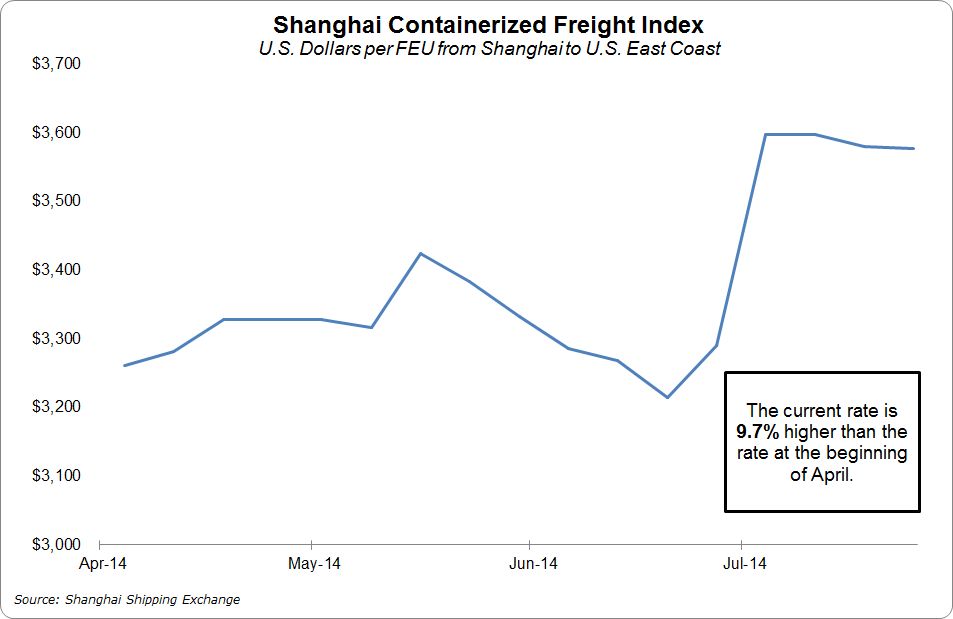
SCFI to U.S. East CoastSpot rates from Shanghai to the U.S. East Coast as tracked by the Shanghai Containerized Freight Index have risen 9.7 percent since April.
Spot rates from Shanghai to the U.S. East Coast as tracked by the Shanghai Containerized Freight Index have risen 9.7 percent since April. This week’s index number showedrates per 40-foot container, or FEU, at $3,578, 8.7 percent higher than the same week in 2013. In July, the U.S. East Coast was the only one of several trade lanes tracked by the SCFI that held on to general rate increases.
Most East Coast ports have seen year-over-year volume gains in May and June, as well. Containerized imports to the U.S. East Coast, compiled by PIERS, the data division of JOC Group, rose 3.6 percent year over year in May and 3 percent in June.
Some ports have performed better. Containerized imports into Boston were up 10.7 percent in May. Charleston saw major gains in both May and June, at 9.9 percent and 16.7 percent respectively. At Port Everglades, May volume was up 17.5 percent year over year in May and 12.7 percent in June. At Savannah, containerized imports surged 17.5 percent in May and 3.1 percent in June. The Port Authority of New York and New Jersey said port terminals handled record container lifts during the first half of 2014
Lilly and Associates advised customers to ship early and allow an additional two weeks on most cargo shipments, but Cabrera said the delays could lead to bigger congestion problems.
“With the tightening capacity and added volumes, there are delays, but then comes the bottlenecks,” Cabrera said. “Then comes the problems at terminals and drayage yards. The delays impact the entire shipping industry’s infrastructure. That’s what comes next.”
Contact Corianne Egan at cegan@joc.com

TARGET, OMNICHANNEL, SUPPLY CHAINS

New Target CEO is from Pepsi. How will he help Target to compete in omnichannel world and its diverse supply chains?


ALIBABA, E-COMMERCE, OMNICHANNEL, SUPPLY CHAINS

Alibaba is highly successful, and the upcoming stock offering is anticipated.  But how well would Alibaba compete in the US market against Amazon and its aggressive supply chain?  What do you think?